Ocean
Great White Shark Dot to Dot — Free 64-Dot Printable for Ages 5–7
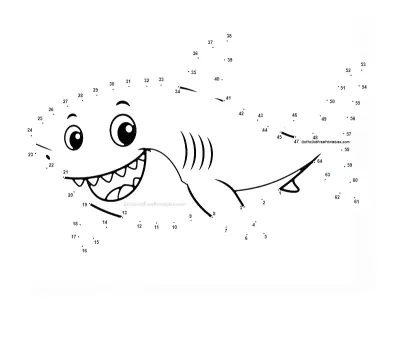
Connect 64 dots to reveal a powerful great white shark cruising through the sea. With 64 dots this is one of the longer easy puzzles in our ocean set, with more dots than the mermaid or whale, making it a good step up for children ready to sharpen their number sequencing and pencil control.
Difficulty
Easy
Fun fact: Great white sharks have such a powerful sense of smell that they can detect tiny traces of blood in the water from far away!
Downloaded9+timesYou’ve made a great choice!
Downloads now start from the button below. Tap it to get this puzzle's PDF.
Free for home and classroom use.
No sign-up needed. Opens as a PDF. Print on US Letter (8.5 × 11 inch) or A4 paper. Free for home and classroom use.
Ocean
You might also like
Ages 5–7 — Easy
How to Solve the Great White Shark Dot-to-Dot Puzzle
The great white shark is one of the ocean's most famous and most misunderstood animals — a powerful, streamlined hunter that has patrolled the seas for millions of years. This 64-dot puzzle is one of the longer easy puzzles in our ocean set, with more dots than the mermaid, whale, or merman, making it a satisfying step up for children ready for extra practice. Find dot 1 and let's meet the ocean's greatest hunter!
1–13 — The Snout and Jaws
Start at dot 1 and connect through to dot 13 to draw the shark's pointed snout and powerful jaw line. This is the most recognisable part of the shark, so encourage children to take their time and follow each dot carefully to get that classic, streamlined shape.
Fun fact!
A great white shark can have up to 300 teeth arranged in several rows at once. When a tooth breaks or falls out, a new one simply moves forward to replace it — sharks can go through tens of thousands of teeth in a lifetime!
A great white shark can have up to 300 teeth arranged in several rows at once. When a tooth breaks or falls out, a new one simply moves forward to replace it — sharks can go through tens of thousands of teeth in a lifetime!
14–26 — The Dorsal Fin
Continue from dot 14 to dot 26 to shape the tall, triangular dorsal fin on the shark's back — the famous fin that breaks the surface of the water.
Fun fact!
A shark's dorsal fin helps keep it stable and stops it from rolling side to side while it swims.
A shark's dorsal fin helps keep it stable and stops it from rolling side to side while it swims.
27–40 — The Streamlined Body
Follow dots 27 through 40 along the long, powerful body that lets the shark glide smoothly through the water.
Fun fact!
A great white's torpedo-shaped body can reach lengths of up to 20 feet — about as long as a small boat!
A great white's torpedo-shaped body can reach lengths of up to 20 feet — about as long as a small boat!
41–52 — The Pectoral Fins
Trace dots 41 through 52 to add the wide pectoral fins near the front of the body, used for steering.
Fun fact!
Pectoral fins act like the wings of a plane, letting the shark steer up, down, left, and right as it swims.
Pectoral fins act like the wings of a plane, letting the shark steer up, down, left, and right as it swims.
53–64 — The Tail Fin and Finish
Finish with dots 53 through 64 to complete the powerful, crescent-shaped tail fin that pushes the shark forward.
Fun fact!
A great white's tail beats side to side to power it through the water at bursts of up to 25 miles per hour.
A great white's tail beats side to side to power it through the water at bursts of up to 25 miles per hour.
Incredible work—your great white shark is ready to patrol the ocean! Colour it in classic ocean grey and white, then add some bubbles and a school of smaller fish nearby. Explore more ocean dot to dot printables to keep the fun going.
Coloring Guide
Great White Shark: Classic Real-Life Colors
A great white is grey above and white below, and this palette sticks to that real counter-shading that hides it in open water.
- 1–13 (The Snout and Jaws): Crayola Gray — A great white's back and pointed snout are slate grey, the colour that hides it against deep water when seen from above.
- 14–26 (The Dorsal Fin): Crayola Gray — The tall dorsal fin is the same grey as the back; it is what people see slicing the surface and it stops the shark rolling.
- 27–40 (The Streamlined Body): Crayola Blue Gray — A blue-grey marks the blurred line where the grey top meets the white belly along the shark's torpedo-shaped body.
- 41–52 (The Pectoral Fins): Crayola Gray — The wing-like pectoral fins stay grey on top, matching the back, since that is the side a diver or seal sees first.
- 53–64 (The Tail Fin and Finish): Crayola White — The underside of the tail is pale, part of the counter-shading that hides the shark from anything looking up at it.
Great White Shark: Soft Natural Colors
These pale greys show the shark in bright, shallow light, when its slate colouring washes out and the blue of the water shows through.
- 1–13 (The Snout and Jaws): Crayola Timberwolf — A pale grey shows the snout the way it looks in bright, shallow water, when the shark's real slate colour washes out.
- 14–26 (The Dorsal Fin): Crayola Timberwolf — Light grey on the fin is how it appears backlit against the sky as it cuts across the surface.
- 27–40 (The Streamlined Body): Crayola Cadet Blue — A soft blue-grey suggests sunlight sliding along the flank as the shark cruises just under the surface.
- 41–52 (The Pectoral Fins): Crayola Timberwolf — Pale grey keeps the steering fins subtle, the way they look lit from above in clear water.
- 53–64 (The Tail Fin and Finish): Crayola Timberwolf — A light neutral grey finishes the tail, matching the way the whole shark pales under strong daylight.
Great White Shark: Bold Real-Life Colors
Charcoal and bright blue push the great white toward a dramatic poster look while keeping the grey-and-white idea.
- 1–13 (The Snout and Jaws): Crayola Outer Space — Near-black makes the jaws look strong and draws the eye to the rows of replaceable teeth a great white is famous for.
- 14–26 (The Dorsal Fin): Crayola Outer Space — A very dark fin stands out sharply, the classic warning shape people picture breaking the water.
- 27–40 (The Streamlined Body): Crayola Cerulean — A bold blue along the body plays up the ocean setting, brighter than the shark's real grey but full of movement.
- 41–52 (The Pectoral Fins): Crayola Outer Space — Charcoal pectoral fins look strong and blade-like, matching the way they work like stiff aeroplane wings.
- 53–64 (The Tail Fin and Finish): Crayola Silver — A metallic silver tail suggests raw speed, the part that drives the shark forward in bursts of up to 25 miles per hour.
Why Is the Great White Shark Dot to Dot Printable Rated Easy?
The Great White Shark is rated easy. Of its 64 dots, 42 run in straight lines, with 9 curved, 5 zigzag and 8 sharp-turn dots. The stretches to slow down for are pectoral fins at dots 46–47 and dorsal fin at dots 23–24. Follow the numbered order even when another dot looks nearer, and check the next number before each turn.
Straight
42 dots · 66%
Easiest — join two dots with one straight pencil stroke.
Curved
9 dots · 14%
23 24
Zigzag
5 dots · 8%
Quick in-and-out changes of direction. Good counting practice.
Sharp turns
8 dots · 13%
46 47
We traced all 64 dots on this exact worksheet by hand — the sharp turns at dots 46–47 is where it got tricky, and you can check that against your own printout.
Key Sections to Know
Every notable stretch of the path, dot by dot.
| Dot Range | Pattern | Why It Matters |
|---|---|---|
| 23 24 | Curved | Follow dorsal fin as it curls from dot 23 to dot 24, easing the line rather than snapping it. |
| 46 47 | Sharp turns | Dots 46–47 cut a sharp corner at pectoral fins; lift your eyes to dot 47 before drawing it. |
Bottom line: The Great White Shark dot to dot is easy rated — 80% smooth lines with just 1 short section to watch for.