Ocean
Merman Dot to Dot — Free 44-Dot Printable for Ages 5–7
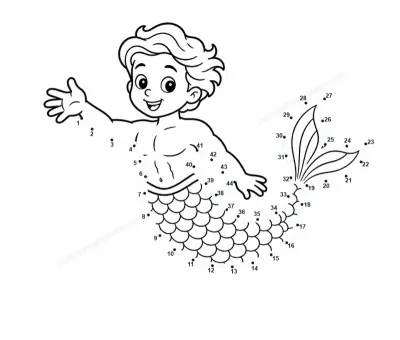
Connect the dots to reveal a magnificent merman rising from the ocean depths! With 44 easy dots, this puzzle is perfect for preschool and kindergarten children practising number sequencing while exploring underwater fantasy.
Difficulty
Easy
Fun fact: Male merfolk (mermen) appear in mythology worldwide — from ancient Greece to the Caribbean!
Downloaded8+timesYou’ve made a great choice!
Downloads now start from the button below. Tap it to get this puzzle's PDF.
Free for home and classroom use.
No sign-up needed. Opens as a PDF. Print on US Letter (8.5 × 11 inch) or A4 paper. Free for home and classroom use.
Ocean
You might also like
Ages 5–7 — Easy
How to Solve the Merman Dot-to-Dot Puzzle
Mermen are the powerful, mysterious kings of the deep ocean — appearing in myths from ancient Greece to the Caribbean, from West Africa to the coastlines of Scotland. Often depicted as fierce rulers of the sea, they are equally at home in quiet lagoons and crashing storms. This 44-dot puzzle is a lovely, manageable challenge for younger children. Grab a pencil and meet the king of the deep!
1–8 — The Head and Face
Start at dot 1 and connect through to dot 8 to sketch the merman's strong, proud face. This introductory section uses gentle curves and helps children settle into the rhythm of the puzzle. Counting each dot aloud is a great way for parents and caregivers to join in from the very beginning.
Fun fact!
In ancient Greek mythology, the sea god Poseidon (Neptune in Roman mythology) was the powerful ruler of the oceans, carrying a trident. His son Triton was a full merman — half man, half fish — who could calm or raise storms by blowing on his conch shell trumpet.
In ancient Greek mythology, the sea god Poseidon (Neptune in Roman mythology) was the powerful ruler of the oceans, carrying a trident. His son Triton was a full merman — half man, half fish — who could calm or raise storms by blowing on his conch shell trumpet.
9–18 — The Arms and Trident
Continue from dot 9 to dot 18 to draw the outstretched arms and the hint of a trident. Children practise drawing extending shapes that reach outward from the body — a different challenge from drawing shapes that curve inward. This section builds directional awareness and confident outward strokes.
Fun fact!
The trident — a three-pronged spear — has been the symbol of sea power in mythology for thousands of years. The word comes from the Latin 'tridens', meaning three teeth. Real-life fishermen across many cultures have used three-pronged spears to catch fish for just as long, so the symbol likely grew from everyday tools.
The trident — a three-pronged spear — has been the symbol of sea power in mythology for thousands of years. The word comes from the Latin 'tridens', meaning three teeth. Real-life fishermen across many cultures have used three-pronged spears to catch fish for just as long, so the symbol likely grew from everyday tools.
19–30 — The Powerful Torso
Trace dots 19 through 30 to fill out the broad, muscular torso. This is the longest section of the puzzle and a great opportunity to build sustained concentration — an important classroom and home skill for children aged 5 to 7. Celebrate reaching dot 30 as a milestone halfway through.
Fun fact!
Mermen appear in Scottish and Irish folklore as the 'Blue Men of the Minch' — magical sea creatures said to live in the strait between Scotland and the Outer Hebrides. Local storytellers imagined these blue-skinned mermen challenging passing sailors to a poetry competition, and letting the best poets sail safely on!
Mermen appear in Scottish and Irish folklore as the 'Blue Men of the Minch' — magical sea creatures said to live in the strait between Scotland and the Outer Hebrides. Local storytellers imagined these blue-skinned mermen challenging passing sailors to a poetry competition, and letting the best poets sail safely on!
31–38 — The Fish Tail
Connect dots 31 to 38 to sweep the fish tail into place. Children see the full merman shape emerge in this section — a satisfying moment that rewards all the careful dot-finding that came before. Flowing, confident downward strokes give the tail its natural movement.
Fun fact!
Olokun, a sea deity in Yoruba mythology from West Africa, is sometimes depicted with a fish tail. Olokun represents the depths of the ocean — mysteries and wealth hidden beneath the waves. A remarkably poetic image.
Olokun, a sea deity in Yoruba mythology from West Africa, is sometimes depicted with a fish tail. Olokun represents the depths of the ocean — mysteries and wealth hidden beneath the waves. A remarkably poetic image.
39–44 — The Tail Fins
Finish by connecting dots 39 through 44 to add the flowing tail fins. Six dots to complete the king of the deep — encourage children to give these final lines real confidence and sweep. A strong finish is always worth taking a breath for before beginning.
Fun fact!
In Irish folklore, merfolk are called merrows, and unlike many mythological sea creatures, they were considered to be generally friendly toward humans — occasionally marrying into fishing families and living on land for a time. The ocean, in these stories, was not a place to fear but a neighbour to respect.
In Irish folklore, merfolk are called merrows, and unlike many mythological sea creatures, they were considered to be generally friendly toward humans — occasionally marrying into fishing families and living on land for a time. The ocean, in these stories, was not a place to fear but a neighbour to respect.
Brilliant work — your merman is ready to rule the deep! This is a wonderful puzzle to pair with a library visit to find books about ocean mythology. Stories from the sea have been inspiring children's imaginations for thousands of years. Explore more of our dot to dot printables 1-100 from the deep.
Coloring Guide
Merman: Classic Real-Life Colors
Mermen belong to myth, so this palette uses the sea-greens and blues that storytellers from Greece to Scotland gave their ocean kings.
- 1–8 (The Head and Face): Crayola Sea Green — Scottish tales describe the Blue Men of the Minch with sea-tinted skin, so a green-blue face fits the merman's mythical colouring.
- 9–18 (The Arms and Trident): Crayola Sky Blue — A cool sky-blue on the arms and three-pronged trident keeps this fishing-spear weapon looking like wet metal under water.
- 19–30 (The Powerful Torso): Crayola Cornflower — The broad torso is the merman's strongest feature, and a steady cornflower blue gives it weight without stealing attention from the tail.
- 31–38 (The Fish Tail): Crayola Sea Green — The tail returns to sea-green, matching the head so the human half and the fish half read as one creature.
- 39–44 (The Tail Fins): Crayola Sky Blue — Pale blue fins spread wide at the end, thin enough that the water seems to show straight through them.
Merman: Soft Natural Colors
Pale silvers and greys show the merman the way he most often appears in real life: a carved statue on a fountain or the prow of a ship.
- 1–8 (The Head and Face): Crayola Silver — Silver gives the face a pale, statue-like look, fitting for a figure carved on ships and fountains like Poseidon.
- 9–18 (The Arms and Trident): Crayola Gray — Plain grey makes the trident look like dull iron and keeps the arms in shadow under bright surface light.
- 19–30 (The Powerful Torso): Crayola White — Near-white across the chest catches the sun the way a swimmer's wet skin shines at midday.
- 31–38 (The Fish Tail): Crayola Silver — Silver scales on the tail flash like a real fish flank turning over in the light.
- 39–44 (The Tail Fins): Crayola Gray — Soft grey lets the fin edges fade, the way thin fins look when held up against a bright sky.
Merman: Bold Real-Life Colors
Bold oranges and browns treat the merman like a painted hero or a wooden figurehead rather than a living creature.
- 1–8 (The Head and Face): Crayola Orange — A fierce orange suits the merman's reputation as a storm-raising king, brighter than any real skin.
- 9–18 (The Arms and Trident): Crayola Red Orange — Red-orange arms look lit by firelight, giving the trident the feel of a hero's weapon in a painting.
- 19–30 (The Powerful Torso): Crayola Brown — Deep brown makes the torso look carved from old wood, like a wooden figurehead on the front of a ship.
- 31–38 (The Fish Tail): Crayola Orange — A blazing orange tail turns the fish half into something bold and decorative rather than lifelike.
- 39–44 (The Tail Fins): Crayola Red Orange — Red-orange fin tips give the king of the deep a dramatic, fiery finish.
Why Is the Merman Dot to Dot Printable Rated Easy?
The Merman is rated easy. Of its 44 dots, 24 run in straight lines, with 12 curved, 5 zigzag and 3 sharp-turn dots. The stretches to slow down for are powerful torso at dots 28–30 and fish tail at dots 33–37. Follow the numbered order even when another dot looks nearer, and check the next number before each curve.
Straight
24 dots · 55%
Easiest — join two dots with one straight pencil stroke.
Curved
12 dots · 27%
33 37
Zigzag
5 dots · 11%
Quick in-and-out changes of direction. Good counting practice.
Sharp turns
3 dots · 7%
The hardest bits — tight corners where the line doubles back.
We traced all 44 dots on this exact worksheet by hand to write this — not a generic guess.
Key Sections to Know
Every notable stretch of the path, dot by dot.
| Dot Range | Pattern | Why It Matters |
|---|---|---|
| 28 30 | Curved | Follow powerful torso as it curls from dot 28 to dot 30, easing the line rather than snapping it. |
| 33 37 | Curved | Around fish tail, the line eases through a smooth bend at dots 33–37; keep the pencil moving slowly. |
Bottom line: The Merman dot to dot is easy rated — 82% smooth lines with no tricky spots to watch for.