Ocean
Whale Dot to Dot — Free 42-Dot Printable for Ages 5–7
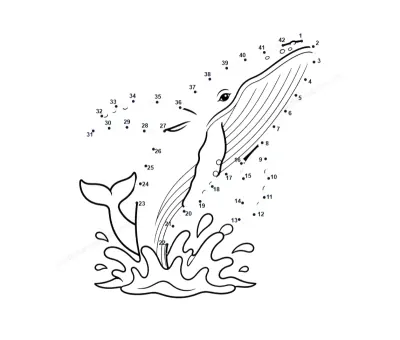
Connect 42 easy dots to reveal a magnificent whale swimming through the ocean. This printable puzzle helps preschool and kindergarten children practise number sequencing, pencil control, and concentration.
Difficulty
Easy
Fun fact: Blue whales are the largest animals known to have ever lived on Earth!
Downloaded15+timesYou’ve made a great choice!
Downloads now start from the button below. Tap it to get this puzzle's PDF.
Free for home and classroom use.
No sign-up needed. Opens as a PDF. Print on US Letter (8.5 × 11 inch) or A4 paper. Free for home and classroom use.
Ocean
You might also like
Ages 5–7 — Easy
How to Solve the Whale Dot-to-Dot Puzzle
The blue whale is the largest animal that has ever lived on our planet — bigger than any dinosaur, bigger than anything that has ever lived on land. And yet, for all their enormous size, whales are gentle, intelligent, deeply social creatures that sing to one another across hundreds of miles of open ocean. This 42-dot puzzle captures that peaceful, unhurried quality. Take a deep breath, find dot 1, and dive in!
1–8 — The Head and Mouth
Start at dot 1 and connect through to dot 8 to draw the whale's broad, rounded head and the gentle curve of the mouth. Baleen whales like the blue whale have some of the most peacefully shaped heads in nature — no teeth, no fierce expression. Children practise wide, slow curves here, matching the whale's own unhurried character.
Fun fact!
A blue whale's heart can weigh about 400 pounds, as heavy as a large motorcycle, and beats only around 8 to 10 times per minute when the whale is diving. When it surfaces, the heart speeds up to 25–37 beats per minute. It is the largest heart of any animal ever known to exist on Earth — truly incredible!
A blue whale's heart can weigh about 400 pounds, as heavy as a large motorcycle, and beats only around 8 to 10 times per minute when the whale is diving. When it surfaces, the heart speeds up to 25–37 beats per minute. It is the largest heart of any animal ever known to exist on Earth — truly incredible!
9–18 — The Back and Dorsal Fin
Continue from dot 9 to dot 18 to trace the long, smooth back and the small dorsal fin. Compared to a dolphin's tall fin, a blue whale's dorsal fin is tiny — children often comment on this, which sparks a lovely discussion about why different animals have different features. Long, flowing strokes work best for this gentle curve.
Fun fact!
Whale skin carries unique patterns of scars, spots, and markings — so distinctive that scientists can identify individual whales from photographs alone. Some whales in long-running studies have been followed for over 30 years. We know individual whales by name, personality, and family history. That is a remarkable thing.
Whale skin carries unique patterns of scars, spots, and markings — so distinctive that scientists can identify individual whales from photographs alone. Some whales in long-running studies have been followed for over 30 years. We know individual whales by name, personality, and family history. That is a remarkable thing.
19–30 — The Belly and Body
Trace dots 19 through 30 to fill out the enormous belly and complete the main body shape. The whale's underside is often a lighter colour than the back — a form of camouflage called countershading, common in ocean animals. Children practise the longest section of the puzzle here, building real concentration stamina.
Fun fact!
A blue whale can eat up to four tonnes of krill — tiny shrimp-like creatures — in a single day. It does this by lunging into a swarm with its mouth open, gulping an enormous quantity of water, then pushing the water out through plates of baleen while the krill stays trapped inside. An elegant, ancient technique.
A blue whale can eat up to four tonnes of krill — tiny shrimp-like creatures — in a single day. It does this by lunging into a swarm with its mouth open, gulping an enormous quantity of water, then pushing the water out through plates of baleen while the krill stays trapped inside. An elegant, ancient technique.
31–36 — The Flippers
Connect dots 31 to 36 to draw the long, paddle-shaped flippers. Whale flippers work like paddles, helping the whale steer and balance as it swims. Children love discovering this when you point it out mid-puzzle.
Fun fact!
Inside a whale flipper are the same bones you have in your own hand — thumb, fingers, wrist, and all. Whales' ancestors walked on land around 50 million years ago, and the flipper is what those legs became over time. Evolution is essentially a very slow, very patient sculptor.
Inside a whale flipper are the same bones you have in your own hand — thumb, fingers, wrist, and all. Whales' ancestors walked on land around 50 million years ago, and the flipper is what those legs became over time. Evolution is essentially a very slow, very patient sculptor.
37–42 — The Tail Flukes
Finish the puzzle by connecting dots 37 through 42 to draw the broad tail flukes that push the whale through the water. Just six dots to complete this gentle giant. Encourage a confident, sweeping finish: the whale deserves a grand conclusion.
Fun fact!
A blue whale's tail flukes can be up to 25 feet wide — wider than many houses. Each downward stroke of those flukes propels the whale forward at up to 20 miles per hour in short bursts. Whale song — produced without any vocal cords — can travel over 1,000 miles through deep ocean water. These animals are extraordinary in almost every imaginable way.
A blue whale's tail flukes can be up to 25 feet wide — wider than many houses. Each downward stroke of those flukes propels the whale forward at up to 20 miles per hour in short bursts. Whale song — produced without any vocal cords — can travel over 1,000 miles through deep ocean water. These animals are extraordinary in almost every imaginable way.
You have just drawn the largest animal on Earth — well done! This puzzle pairs beautifully with a conversation about ocean conservation. Whales were hunted almost to extinction last century and are now slowly recovering. Children who love whales today are exactly the kind of people who will protect them tomorrow. Explore more ocean dot to dot printables to keep the fun going.
Coloring Guide
Whale: Classic Real-Life Colors
Deep water turns a whale blue-green in the sun, and these gentle sea tones show the animal the way a diver might glimpse it.
- 1–8 (The Head and Mouth): Crayola Sea Green — A blue whale looks blue-green underwater as sunlight filters down, and this soft shade catches the broad head in that light.
- 9–18 (The Back and Dorsal Fin): Crayola Sky Blue — The long back and its surprisingly tiny dorsal fin take a light sky-blue, the colour a whale's top shows near the surface.
- 19–30 (The Belly and Body): Crayola Cornflower — Whales are counter-shaded, darker above and paler below, so a mid cornflower blue sits between those two tones on the body.
- 31–36 (The Flippers): Crayola Sea Green — The flippers hold the same bones as a human hand, and matching them to the head keeps the whole animal one smooth colour.
- 37–42 (The Tail Flukes): Crayola Sky Blue — The huge flukes get a pale blue so their thin trailing edge looks like it is slicing through sunlit water.
Whale: Soft Natural Colors
Real whales are mostly grey and white, marked all over with scars, and this quiet palette stays close to how they actually look.
- 1–8 (The Head and Mouth): Crayola Silver — Grey whales and pale scarred skin really do look silver in the sun, which suits the broad, gentle head.
- 9–18 (The Back and Dorsal Fin): Crayola Gray — Plain grey is close to a real whale's back, covered in the scars scientists use to tell individuals apart.
- 19–30 (The Belly and Body): Crayola White — The underside of many whales is genuinely white or cream, part of the counter-shading that hides them from below.
- 31–36 (The Flippers): Crayola Silver — Silver keeps the paddle-shaped flippers light, the way wet skin flashes when a whale rolls at the surface.
- 37–42 (The Tail Flukes): Crayola Gray — Soft grey matches the pale underside a whale shows as its tail lifts clear of the water before a dive.
Whale: Bold Real-Life Colors
No whale is orange or brown, so this bold palette is for a bright picture-book whale rather than a lifelike one.
- 1–8 (The Head and Mouth): Crayola Orange — Whales are never orange, but this bold shade picks out the head and the long lines of baleen inside the mouth.
- 9–18 (The Back and Dorsal Fin): Crayola Red Orange — A strong red-orange along the back turns the whale into a bright poster picture rather than a photograph.
- 19–30 (The Belly and Body): Crayola Brown — Deep brown on the belly stands in for the barnacles and old scarring that build up on a whale's underside.
- 31–36 (The Flippers): Crayola Orange — Bright orange flippers make it easy to point out where a whale's hidden hand and arm bones sit.
- 37–42 (The Tail Flukes): Crayola Red Orange — Red-orange flukes give this gentle giant a big, dramatic finish, wider than a house at full size.
Why Is the Whale Dot to Dot Printable Rated Easy?
The Whale is rated easy. Of its 42 dots, 28 run in straight lines, with 6 curved, 3 zigzag and 5 sharp-turn dots. The stretch to slow down for is head and mouth at dots 2–3. Follow the numbered order even when another dot looks nearer, and check the next number before each curve.
Straight
28 dots · 67%
Easiest — join two dots with one straight pencil stroke.
Curved
6 dots · 14%
2 3
Zigzag
3 dots · 7%
Quick in-and-out changes of direction. Good counting practice.
Sharp turns
5 dots · 12%
The hardest bits — tight corners where the line doubles back.
We traced all 42 dots on this exact worksheet by hand to write this — not a generic guess.
Key Sections to Know
Every notable stretch of the path, dot by dot.
| Dot Range | Pattern | Why It Matters |
|---|---|---|
| 2 3 | Curved | The outline swings around head and mouth here; take dots 2 to 3 in short strokes. |
Bottom line: The Whale dot to dot is easy rated — 81% smooth lines with no tricky spots to watch for.