Dinosaurs
T-Rex Dot to Dot — 61 Dots of Prehistoric Fun
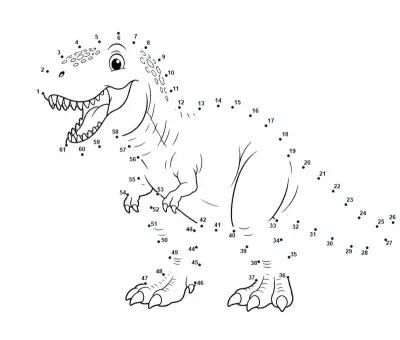
Connect 61 dots to reveal a mighty Tyrannosaurus Rex. This printable dinosaur worksheet gives young counters a longer number-sequencing challenge while building pencil control, focus, and fine motor skills.
Difficulty
Easy
Fun fact: T-Rex could replace its teeth throughout its life, growing new ones when older teeth broke or fell out!
Downloaded119+timesYou’ve made a great choice!
Downloads now start from the button below. Tap it to get this puzzle's PDF.
Free for home and classroom use.
No sign-up needed. Opens as a PDF. Print on US Letter (8.5 × 11 inch) or A4 paper. Free for home and classroom use.
Dinosaurs
You might also like
Ages 5–7 — Easy
How to Solve the T-Rex 61-Dot Challenge Dot-to-Dot Puzzle
Sixty-one dots is a longer count — and a fitting one, because Tyrannosaurus Rex was a real giant. This puzzle has more dots than many of our free dot to dot printables, so it suits children who have already mastered counting past 50 and want something meatier. Find dot 1 right at the tip of the jaw, take a breath, and let's wake up the king of the dinosaurs.
1–11 — The Massive Head and Snout
Start at dot 1 on the tip of that toothy jaw and work up and over the head to dot 11 at the base of the neck. The strokes here are short and curved, which makes this a gentle warm-up before the long lines to come. Ask your child what they notice about the head — it's enormous compared to everything else, and that's no accident.
Fun fact!
A full-grown T-Rex skull was about five feet long — taller than most eight-year-olds. Scientists believe its bite was the strongest of any land animal that has ever lived, powerful enough to crush bone.
A full-grown T-Rex skull was about five feet long — taller than most eight-year-olds. Scientists believe its bite was the strongest of any land animal that has ever lived, powerful enough to crush bone.
12–26 — Along the Back to the Tail Tip
From dot 12, the line sweeps along the back and all the way down the tail to dot 26 at the very tip. This is the longest, smoothest stretch of the puzzle. Encourage one flowing motion rather than lots of stops and starts — it's excellent practice for the sustained pencil control children need when they begin joined-up writing.
Fun fact!
The tail made up almost half of a T-Rex's total length and held more than 40 bones. It worked like a tightrope walker's pole, balancing that huge head so the dinosaur didn't tip forward onto its face.
The tail made up almost half of a T-Rex's total length and held more than 40 bones. It worked like a tightrope walker's pole, balancing that huge head so the dinosaur didn't tip forward onto its face.
27–35 — Under the Tail to the Hip
Now double back. Dots 27 to 35 run underneath the tail toward the hip, tracing the thick underside of that mighty balancing beam. Children have to count carefully here because the dots sit close together — a good moment to slow down and check each number before drawing.
Fun fact!
Standing at the hip, a T-Rex was around 12 feet tall. Its whole body could stretch to 40 feet from nose to tail tip — about the length of a school bus.
Standing at the hip, a T-Rex was around 12 feet tall. Its whole body could stretch to 40 feet from nose to tail tip — about the length of a school bus.
36–48 — The Powerful Legs and Feet
Dots 36 to 48 build the back legs and both clawed feet. These were the engine of the whole animal, and the section rewards bold, confident strokes. There's a bit of zig-zagging between the toes, so it also sneaks in some fine motor practice right when children think they're just drawing dinosaur feet.
Fun fact!
One T-Rex footprint could be over three feet long. For years people argued about how fast it could move — current research suggests a walking pace of about 3 mph and short bursts closer to 12 mph. Fast enough.
One T-Rex footprint could be over three feet long. For years people argued about how fast it could move — current research suggests a walking pace of about 3 mph and short bursts closer to 12 mph. Fast enough.
49–58 — The Belly and Those Tiny Arms
Connect dots 49 through 58 to draw the belly, chest, and the famously small arms. Every child laughs at these arms, which is exactly why this section is fun to draw. The lines change direction often, so it's the trickiest part of the puzzle — perfect for the confident counters this 61-dot page was made for.
Fun fact!
Those little arms were only about three feet long, yet each one could lift roughly 400 pounds. Small, yes — but nobody would call them weak.
Those little arms were only about three feet long, yet each one could lift roughly 400 pounds. Small, yes — but nobody would call them weak.
59–61 — Closing the Jaw
Just three dots left. Connect 59, 60, and 61 to finish the lower jaw and complete the mighty outline. The final line lands right back near dot 1 — a satisfying full circle that shows children the whole picture was one continuous journey.
Fun fact!
T-Rex never ran out of teeth. When one broke or wore down, a new one simply grew in its place — a lifetime supply of dagger-sharp replacements, some up to 12 inches long including the root.
T-Rex never ran out of teeth. When one broke or wore down, a new one simply grew in its place — a lifetime supply of dagger-sharp replacements, some up to 12 inches long including the root.
That's 61 dots conquered! Ready for more? Explore more dinosaur dot to dot printables to keep the fun going.
Coloring Guide
T-Rex 61-Dot Challenge: Classic Real-Life Colors
Museum models and dinosaur books almost always show T-Rex in muted greens and browns, the shades that would hide a big hunter among conifers and ferns.
- 1–11 (The Massive Head and Snout): Crayola Olive Green — Olive green over the massive five-foot skull matches how most illustrations shade a predator's head, dark enough to hide the bone-crushing jaw among the trees.
- 12–26 (Along the Back to the Tail Tip): Crayola Forest Green — Forest green runs the long back and forty-bone tail, the classic countershading that would break up the outline of an animal as long as a school bus.
- 27–35 (Under the Tail to the Hip): Crayola Brown — Brown along the underside of that balancing tail suggests the shadowed skin beneath, always painted darker where sunlight never reaches.
- 36–48 (The Powerful Legs and Feet): Crayola Olive Green — Olive green on the pillar legs and clawed three-toed feet keeps the walking limbs the same woodland tone reconstructions give the rest of the body.
- 49–58 (The Belly and Those Tiny Arms): Crayola Forest Green — Forest green across the chest and those famous two-fingered arms ties the small forelimbs into the body colour instead of drawing the eye to them.
- 59–61 (Closing the Jaw): Crayola Brown — Brown on the lower jaw hints at the tougher, drier skin around a mouth full of replaceable teeth up to twelve inches long.
T-Rex 61-Dot Challenge: Soft Natural Colors
Under the open sun of a Cretaceous flood plain a huge reptile's hide would bleach toward dusty grey, the way elephant and rhino skin looks pale in bright light.
- 1–11 (The Massive Head and Snout): Crayola Gray — Pale grey shows the five-foot skull as it would look in glare, the raised bony brow washed out above the eye.
- 12–26 (Along the Back to the Tail Tip): Crayola Silver — Silver-grey along the spine and tail is how a sun-faded hide reads at midday, the ridged backbone catching the light.
- 27–35 (Under the Tail to the Hip): Crayola Tan — Warm tan under the tail stands in for softer, less weathered skin tucked in the shade of the hip.
- 36–48 (The Powerful Legs and Feet): Crayola Gray — Grey on the legs and feet keeps the heavy limbs in the same bleached tone, with the toe claws left a shade lighter.
- 49–58 (The Belly and Those Tiny Arms): Crayola Silver — Silver-grey over the belly and the little arms lets the pale underside almost fade into the paper.
- 59–61 (Closing the Jaw): Crayola Tan — Tan on the closing jaw warms the lip line where thin skin stretches over the tooth row.
T-Rex 61-Dot Challenge: Bold Real-Life Colors
Some artists paint T-Rex as a showy animal in rusty reds and gold, the bold warning colours you still see on big living reptiles and birds.
- 1–11 (The Massive Head and Snout): Crayola Raw Sienna — Raw sienna gives the huge head a rusty cast, the kind of bright face marking that would signal to rivals across open ground.
- 12–26 (Along the Back to the Tail Tip): Crayola Mahogany — Deep mahogany down the back and tail reads like a bold stripe running the whole forty feet from nose to tip.
- 27–35 (Under the Tail to the Hip): Crayola Goldenrod — Goldenrod under the tail flashes a lighter belly band, a contrast many display animals carry low on the body.
- 36–48 (The Powerful Legs and Feet): Crayola Raw Sienna — Raw sienna on the powerful legs makes the running muscle the strongest colour on the animal.
- 49–58 (The Belly and Those Tiny Arms): Crayola Mahogany — Mahogany across the chest and arms turns even the tiny forelimbs into part of a striking pattern.
- 59–61 (Closing the Jaw): Crayola Goldenrod — Goldenrod on the lower jaw lights up the mouthline and its ever-growing dagger teeth.
Why Is the T-Rex 61-Dot Challenge Dot to Dot Printable Rated Easy?
The T-Rex 61-Dot Challenge is rated easy. Its 61 dots are 29 straight, 14 curved, 11 zigzag and 7 sharp-turn dots. The stretches to slow down for are powerful legs and feet at dots 36–37 and belly and those tiny arms at dots 53–54. Follow the numbered order even when another dot looks nearer, and check the next number before each turn.
Straight
29 dots · 48%
Easiest — join two dots with one straight pencil stroke.
Curved
14 dots · 23%
8 9
Zigzag
11 dots · 18%
Quick in-and-out changes of direction. Good counting practice.
Sharp turns
7 dots · 11%
36 37
We traced all 61 dots on this exact worksheet by hand — the sharp turns at dots 36–37 is where it got tricky, and you can check that against your own printout.
Key Sections to Know
Every notable stretch of the path, dot by dot.
| Dot Range | Pattern | Why It Matters |
|---|---|---|
| 8 9 | Curved | Dots 8–9 round off massive head and snout — connect them one at a time so the arc stays even. |
| 27 28 | Curved | The outline swings around under the tail to the hip here; take dots 27 to 28 in short strokes. |
| 36 37 | Sharp turns | There is a tight angle at powerful legs and feet here; treat dots 36 and 37 as two separate short lines. |
| 42 43 | Curved | Follow powerful legs and feet as it curls from dot 42 to dot 43, easing the line rather than snapping it. |
| 53 54 | Sharp turns | Dots 53–54 cut a sharp corner at belly and those tiny arms; lift your eyes to dot 54 before drawing it. |
Bottom line: The T-Rex 61-Dot Challenge dot to dot is easy rated — 70% smooth lines with just 2 short sections to watch for.