Playgrounds
Playground Slide Dot to Dot — Free 102-Dot Printable for Ages 5–8
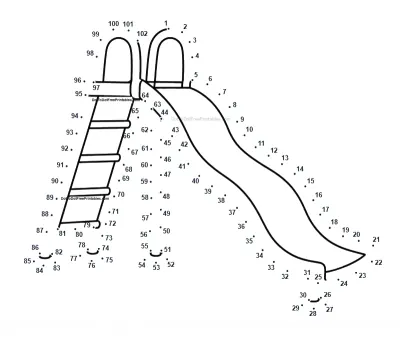
Connect 102 dots to reveal a tall playground slide, ready for climbing and sliding. With more dots than our easiest playground puzzle, this one is a nice next challenge for kids who are ready for a little more than the starter sheets while still enjoying a fun, familiar subject.
Difficulty
Medium
Fun fact: Playground slides usually end in a gentle exit section so riders slow down before they reach the ground.
Downloaded45+timesYou’ve made a great choice!
Downloads now start from the button below. Tap it to get this puzzle's PDF.
Number Version
Connect the numbered dots from 1 to the end to reveal the picture.
Free for home and classroom use.
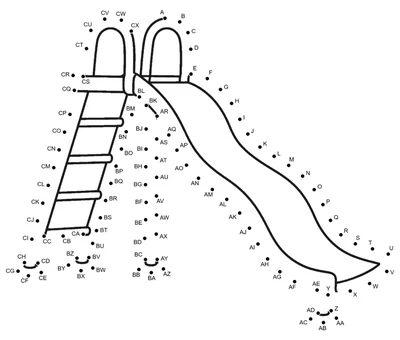
Alphabet Version
Includes alphabet-themed design for easy learning.
No sign-up needed. Opens as a PDF. Print on US Letter (8.5 × 11 inch) or A4 paper. Free for home and classroom use.
Playgrounds
You might also like
Ages 5–8 — Medium
How to Solve the Slide Playground Dot-to-Dot Puzzle
If the swing is the king of the playground, the slide is a very close second — there's something irresistible about climbing up, sitting down, and letting gravity do the rest. This 102-dot puzzle traces a tall, classic playground slide from the ladder at the back to the curved ramp at the front. It has more dots than our easiest playground sheet, so it rewards a bit of extra patience. Find dot 1, and let's build something worth climbing.
1–20 — The Ladder
Start at dot 1 and connect through to dot 20 to draw the tall ladder that leads up to the slide's platform. This section is mostly straight, evenly spaced lines, which makes it a good warm-up for steady, controlled pencil strokes before the curves ahead.
Fun fact!
Playground ladders are built with rungs spaced closely enough that a young child's foot can reach the next one safely — usually no more than about 12 inches apart, much closer together than the rungs on a household stepladder.
Playground ladders are built with rungs spaced closely enough that a young child's foot can reach the next one safely — usually no more than about 12 inches apart, much closer together than the rungs on a household stepladder.
21–40 — The Platform
Continue from dot 21 to dot 40 to draw the flat platform at the top, where climbers pause before sliding down. Children practise connecting horizontal and vertical lines at clean right angles here — good practice for structure and proportion.
Fun fact!
Most playground platforms are built with guardrails on at least three sides, leaving only the slide entrance open. Guardrails like these help keep children from falling off the platform.
Most playground platforms are built with guardrails on at least three sides, leaving only the slide entrance open. Guardrails like these help keep children from falling off the platform.
41–60 — The Top of the Slide
Trace dots 41 through 60 to shape the curved lip where the platform meets the slide itself — the exact spot where the fun begins. This is a tighter curve than it looks, so encourage a slow, deliberate hand rather than a fast sweep.
Fun fact!
The curve at the top of a slide is shaped so a rider eases into the descent rather than dropping straight down.
The curve at the top of a slide is shaped so a rider eases into the descent rather than dropping straight down.
61–85 — The Long Chute
Connect dots 61 to 85 to draw the long, sweeping slide itself. This is the biggest and most satisfying section of the puzzle — encourage one smooth, continuous stroke rather than several short ones, since that's what gives the slide its sense of speed.
Fun fact!
Modern playground slides are almost always made from rotomoulded plastic rather than metal. Metal slides can become dangerously hot in direct summer sun, which is one of the main reasons playgrounds largely switched materials starting in the 1980s and 90s.
Modern playground slides are almost always made from rotomoulded plastic rather than metal. Metal slides can become dangerously hot in direct summer sun, which is one of the main reasons playgrounds largely switched materials starting in the 1980s and 90s.
86–102 — The Base and Landing
Finish by connecting dots 86 through 102 to draw the base of the slide and the ground where riders land. Seventeen dots to go — a confident, grounded finish here completes the whole structure.
Fun fact!
Just like swings, slides sit over specially engineered safety surfacing — usually rubber, sand, or wood chips — designed to absorb the impact of a landing far better than plain grass or concrete ever could.
Just like swings, slides sit over specially engineered safety surfacing — usually rubber, sand, or wood chips — designed to absorb the impact of a landing far better than plain grass or concrete ever could.
Great job — your slide is ready for climbers! Colour it in bright playground colours, or design your own wild pattern down the chute. Explore more playground dot to dot printables to keep the fun going.
Coloring Guide
Slide Playground: Classic Real-Life Colors
A real playground slide is coated steel and thick moulded plastic over soft surfacing, and this palette keeps the ladder, platform, curve, chute and landing close to that.
| Dot Range | Part | Color | Why this color | |
|---|---|---|---|---|
| Numeric | Alphabet | |||
| 1–20 | A–T | The Ladder | Crayola Scarlet | Slide ladders are coated steel, the rails and rungs kept a strong colour so each step is easy to see on the way up. |
| 21–40 | U–AN | The Platform | Crayola Sky Blue | The top platform is moulded plastic with steel guardrails, usually a bright block colour that matches the chute. |
| 41–60 | AO–BH | The Top of the Slide | Crayola Goldenrod | The starter curve is the same rotomoulded plastic as the chute, formed in one piece so there is no seam to catch on. |
| 61–85 | BI–CG | The Long Chute | Crayola Scarlet | Modern chutes are thick rotomoulded plastic, chosen over metal because plastic does not bake hot in the sun. |
| 86–102 | CH–CX | The Base and Landing | Crayola Brown | The slide's foot flattens out over loose safety surfacing, rubber or sand or wood chips in mixed earthy tones. |
Slide Playground: Soft Natural Colors
This lighter set shows the slide under strong sun, when the plastic glares pale and the metal ladder turns silvery.
| Dot Range | Part | Color | Why this color | |
|---|---|---|---|---|
| Numeric | Alphabet | |||
| 1–20 | A–T | The Ladder | Crayola Silver | Under a strong sky the metal ladder turns pale and silvery, its colour thinned by glare off every rung. |
| 21–40 | U–AN | The Platform | Crayola Tan | Strong daylight lifts the platform plastic to a pale, washed tint and makes the guardrails glint. |
| 41–60 | AO–BH | The Top of the Slide | Crayola Sea Green | Sunlight pools on the curved lip, so this spot looks the palest and shiniest part of the whole slide. |
| 61–85 | BI–CG | The Long Chute | Crayola Silver | A glossy chute in full sun reflects the sky down its length, reading far lighter than the plastic really is. |
| 86–102 | CH–CX | The Base and Landing | Crayola Tan | Dry and sunlit, the landing surface fades to a pale, dusty tan. |
Slide Playground: Bold Real-Life Colors
This bolder set is a freshly built slide: new powder-coat on the steel, dense bright plastic and dark springy surfacing below.
| Dot Range | Part | Color | Why this color | |
|---|---|---|---|---|
| Numeric | Alphabet | |||
| 1–20 | A–T | The Ladder | Crayola Forest Green | A deeper colour matches a fresh powder-coat on the steel rungs, baked on to hold off rust for years. |
| 21–40 | U–AN | The Platform | Crayola Brown | A stronger shade suits the thick UV-proof plastic used for a deck that takes constant standing and turning. |
| 41–60 | AO–BH | The Top of the Slide | Crayola Orange | A richer tone stands in for the dense moulded plastic at the busiest, most-gripped part of the ride. |
| 61–85 | BI–CG | The Long Chute | Crayola Forest Green | A bold finish reflects the heavy rotomoulded plastic built to stay smooth over thousands of rides. |
| 86–102 | CH–CX | The Base and Landing | Crayola Brown | A deep brown matches fresh wood-fibre surfacing, dark and springy where riders land. |
Why Is the Slide Playground Dot to Dot Printable Rated Medium?
The Slide Playground is rated medium. Of its 102 dots, 64 run in straight lines, with 16 curved, 8 zigzag and 14 sharp-turn dots. The stretches to slow down for are base and landing at dots 96–97 and ladder at dots 2–3. Follow the numbered order even when another dot looks nearer, and check the next number before each turn.
Straight
64 dots · 63%
Easiest — join two dots with one straight pencil stroke.
Curved
16 dots · 16%
2 3
Zigzag
8 dots · 8%
Quick in-and-out changes of direction. Good counting practice.
Sharp turns
14 dots · 14%
96 97
We traced all 102 dots on this exact worksheet by hand — the sharp turns at dots 96–97 is where it got tricky, and you can check that against your own printout.
Key Sections to Know
Every notable stretch of the path, dot by dot.
| Dot Range | Pattern | Why It Matters | |
|---|---|---|---|
| Numeric | Alphabet | ||
| 2 3 | B C | Curved | The outline swings around ladder here; take dots 2 to 3 in short strokes. |
| 81 82 | CC CD | Curved | A gentle curve shapes long chute across dots 81–82. Spot dot 82 before you commit to the line. |
| 96 97 | CR CS | Sharp turns | The line changes direction hard at dots 96–97, on base and landing — stop at 96, find 97, then turn. |
| 100 101 | CV CW | Curved | Around base and landing, the line eases through a smooth bend at dots 100–101; keep the pencil moving slowly. |
Bottom line: The Slide Playground dot to dot is medium rated — 78% smooth lines with just 1 short section to watch for.