
America 250 Years
Astronaut Dot to Dot — Free 63-Dot Printable for Ages 5–8
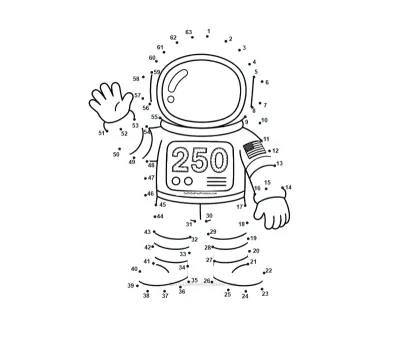
Connect 63 dots to reveal a heroic astronaut celebrating America's 250th anniversary! This free printable worksheet helps young children practise number sequencing and pencil control while honouring 250 years of American history and the spirit of exploration. Perfect for ages 5–8.
Difficulty
Medium
Fun fact: The United States was the first country to land humans on the Moon. On July 20, 1969 — just 193 years after the Declaration of Independence — Neil Armstrong and Buzz Aldrin took humanity's first steps on the lunar surface.
Downloaded2+timesYou’ve made a great choice!
Downloads now start from the button below. Tap it to get this puzzle's PDF.
Number Version
Connect the numbered dots from 1 to the end to reveal the picture.
Free for home and classroom use.
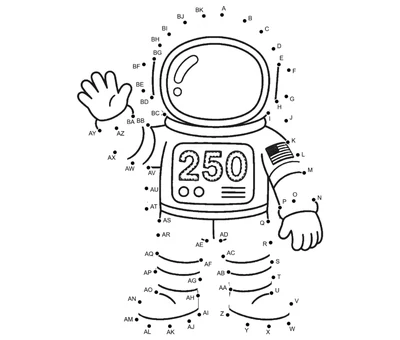
Alphabet Version
Includes alphabet-themed design for easy learning.
No sign-up needed. Opens as a PDF. Print on US Letter (8.5 × 11 inch) or A4 paper. Free for home and classroom use.
America 250 Years
You might also like

Ages 5–8 — Medium
How to Solve the America 250 Astronaut Dot-to-Dot Puzzle
America is turning 250 years old — and few things capture the American spirit of adventure better than an astronaut! From the first rockets of the Space Race to the Moon landings and beyond, American explorers have always reached for the stars. Grab a pencil, find dot 1, and let's suit up for liftoff!
1–14 — The Helmet
Start at dot 1 and connect through to dot 14 to trace the rounded astronaut helmet. The visor and curved outer shell give children a wonderful warm-up with smooth, wide arcs that build confident pencil control from the very first stroke.
Fun fact!
Astronaut helmets are made from layers of polycarbonate and other tough materials. The golden visor is coated with a thin layer of real gold, which reflects solar radiation and protects astronauts' eyes from the intense sunlight in space.
Astronaut helmets are made from layers of polycarbonate and other tough materials. The golden visor is coated with a thin layer of real gold, which reflects solar radiation and protects astronauts' eyes from the intense sunlight in space.
15–30 — The Spacesuit Torso
Continue from dot 15 to dot 30 to outline the broad torso of the spacesuit. Children practise longer connecting strokes here, drawing the sturdy shoulders and chest that give the astronaut figure its characteristic boxy, powerful shape.
Fun fact!
A full NASA spacesuit, called an Extravehicular Mobility Unit (EMU), weighs about 275 pounds on Earth. In orbit astronauts feel weightless, but the suit keeps its mass and can be surprisingly hard to start or stop moving! It takes up to 45 minutes for an astronaut to put one on.
A full NASA spacesuit, called an Extravehicular Mobility Unit (EMU), weighs about 275 pounds on Earth. In orbit astronauts feel weightless, but the suit keeps its mass and can be surprisingly hard to start or stop moving! It takes up to 45 minutes for an astronaut to put one on.
31–44 — The Arms and Gloves
Trace dots 31 through 44 to draw the astronaut's arms and bulky gloves. This section features more angular direction changes, which helps children develop the ability to stop, aim, and start a new line — a skill that builds careful number-tracking too.
Fun fact!
Spacesuit gloves are one of the most complex parts of the suit. They must be flexible enough for astronauts to grip tools and work with their fingers, while being strong enough to protect against temperature swings of more than 500 degrees Fahrenheit in space.
Spacesuit gloves are one of the most complex parts of the suit. They must be flexible enough for astronauts to grip tools and work with their fingers, while being strong enough to protect against temperature swings of more than 500 degrees Fahrenheit in space.
45–56 — The Legs and Boots
Connect dots 45 through 56 to complete the lower half of the spacesuit — the legs and thick boots. Children practise steady, parallel lines here, which is great for building consistency and control as they near the end of the puzzle.
Fun fact!
Moon boots worn during the Apollo missions had a special outer sole made from a woven metal fabric called chromel-R. It protected astronauts' feet from the extreme temperatures of the lunar surface, which can range from −280°F in shadow to +260°F in sunlight.
Moon boots worn during the Apollo missions had a special outer sole made from a woven metal fabric called chromel-R. It protected astronauts' feet from the extreme temperatures of the lunar surface, which can range from −280°F in shadow to +260°F in sunlight.
57–63 — The American Flag and Finishing Details
Finish the puzzle by connecting dots 57 through 63 to add the American flag patch and the final details that bring the whole astronaut to life. Just seven dots to go — encourage children to make these last lines their neatest and most precise!
Fun fact!
American astronauts have worn a flag patch on the left shoulder of their spacesuit since the Apollo missions. Six American flags were planted on the Moon between 1969 and 1972, and NASA lunar images suggest that most of them are still standing today.
American astronauts have worn a flag patch on the left shoulder of their spacesuit since the Apollo missions. Six American flags were planted on the Moon between 1969 and 1972, and NASA lunar images suggest that most of them are still standing today.
Outstanding work — your America 250 astronaut is ready for launch! That's 63 dots and one incredible symbol of American exploration and courage. Colour the spacesuit white and add patriotic red, white, and blue details to send your astronaut soaring in style. Happy 250th birthday, USA — ad astra (to the stars)! Explore more space dot to dot puzzles to keep the fun going.
Coloring Guide
America 250 Astronaut: Classic Real-Life Colors
A real NASA spacesuit is white with a gold visor and a shoulder flag; this palette keeps the flag's own red and blue.
| Dot Range | Part | Color | Why this color | |
|---|---|---|---|---|
| Numeric | Alphabet | |||
| 1–14 | A–N | The Helmet | Crayola Scarlet | The helmet shell is clear polycarbonate with a gold-filmed visor that blocks glare; red outlines it in the scene. |
| 15–30 | O–AD | The Spacesuit Torso | Crayola Sky Blue | The hard torso holds the life-support pack; the whole suit is really white, so blue just marks the shape. |
| 31–44 | AE–AR | The Arms and Gloves | Crayola Goldenrod | Gold matches the visor film and suits gloves built to work from far below freezing to well above boiling. |
| 45–56 | AS–BD | The Legs and Boots | Crayola Scarlet | Apollo Moon boots had woven-metal soles; red picks them out at the base of the figure. |
| 57–63 | BE–BK | The American Flag and Finishing Details | Crayola Sky Blue | US astronauts have worn a left-shoulder flag patch since Apollo; blue is its true field colour. |
America 250 Astronaut: Soft Natural Colors
Lit by harsh sunlight in orbit the white suit reads as bright silver-grey with pale shadows.
| Dot Range | Part | Color | Why this color | |
|---|---|---|---|---|
| Numeric | Alphabet | |||
| 1–14 | A–N | The Helmet | Crayola Silver | The domed helmet catches sunlight as a hard silver highlight against black space. |
| 15–30 | O–AD | The Spacesuit Torso | Crayola Tan | Folds and wear on the fabric torso pick up a warm off-white, close to tan. |
| 31–44 | AE–AR | The Arms and Gloves | Crayola Sea Green | Soft green suits the shaded joints of the arms where sunlight does not reach. |
| 45–56 | AS–BD | The Legs and Boots | Crayola Silver | The stiff boots reflect the same silvery glare as the rest of the sunlit suit. |
| 57–63 | BE–BK | The American Flag and Finishing Details | Crayola Tan | In full sun the shoulder patch looks faded and pale rather than sharply coloured. |
America 250 Astronaut: Bold Real-Life Colors
Deeper tones bring out the suit as heavy engineered gear - layered fabric, metal fittings and scuffed boots.
| Dot Range | Part | Color | Why this color | |
|---|---|---|---|---|
| Numeric | Alphabet | |||
| 1–14 | A–N | The Helmet | Crayola Forest Green | Dark green gives the helmet ring and seals the look of machined, load-bearing hardware. |
| 15–30 | O–AD | The Spacesuit Torso | Crayola Brown | Brown reads like the many tough outer layers stitched into the 280-pound torso. |
| 31–44 | AE–AR | The Arms and Gloves | Crayola Orange | Burnt orange picks out the gloves, the most worked and worn part of any spacesuit. |
| 45–56 | AS–BD | The Legs and Boots | Crayola Forest Green | Strong green suits boots scuffed on grit that swings between deep cold and searing heat. |
| 57–63 | BE–BK | The American Flag and Finishing Details | Crayola Brown | Deep brown gives the flag patch and trim the look of gear flown on real missions. |
Why Is the America 250 Astronaut Dot to Dot Printable Rated Medium?
The America 250 Astronaut is rated medium. Its 63 dots split into 27 straight, 14 curved, 17 zigzag and 5 sharp-turn dots — the direction changes are what lift it above an easy outline. The stretches to slow down for are legs and boots at dots 52–54 and spacesuit torso at dots 16–17. Follow the numbered order even when another dot looks nearer, and check the next number before each turn.
Straight
27 dots · 43%
Easiest — join two dots with one straight pencil stroke.
Curved
14 dots · 22%
38 40
Zigzag
17 dots · 27%
52 54
Sharp turns
5 dots · 8%
The hardest bits — tight corners where the line doubles back.
We traced all 63 dots on this exact worksheet by hand — the zigzag at dots 52–54 is where it got tricky, and you can check that against your own printout.
Key Sections to Know
Every notable stretch of the path, dot by dot.
| Dot Range | Pattern | Why It Matters | |
|---|---|---|---|
| Numeric | Alphabet | ||
| 16 17 | P Q | Curved | A gentle curve shapes spacesuit torso across dots 16–17. Spot dot 17 before you commit to the line. |
| 25 26 | Y Z | Curved | Follow spacesuit torso as it curls from dot 25 to dot 26, easing the line rather than snapping it. |
| 38 40 | AL AN | Curved | Around arms and gloves, the line eases through a smooth bend at dots 38–40; keep the pencil moving slowly. |
| 52 54 | AZ BB | Zigzag | The line saw-tooths along legs and boots from dot 52 to dot 54; check every number as you go. |
Bottom line: The America 250 Astronaut dot to dot is medium rated — 65% smooth lines with just 1 short section to watch for.