America 250 Years
Gas Balloon Dot to Dot — Free 48-Dot Printable for Ages 5–7
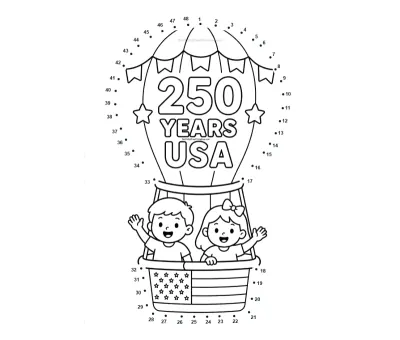
Connect 48 easy dots to reveal a magnificent gas balloon soaring over the America 250th anniversary celebration! This free printable worksheet helps young children practise number sequencing and pencil control while honouring 250 years of American history.
Difficulty
Easy
Fun fact: The first gas balloon flight in America took place in 1793 — George Washington himself watched it launch in Philadelphia!
Downloaded5+timesYou’ve made a great choice!
Downloads now start from the button below. Tap it to get this puzzle's PDF.
Free for home and classroom use.
No sign-up needed. Opens as a PDF. Print on US Letter (8.5 × 11 inch) or A4 paper. Free for home and classroom use.
America 250 Years
You might also like
Ages 5–7 — Easy
How to Solve the Gas Balloon America 250 Dot-to-Dot Puzzle
America is turning 250 years old — a quarter millennium of history, invention, and adventure! What better way to celebrate than soaring above the festivities in a magnificent gas balloon? Gas balloons were one of the very first flying machines, and Americans have loved them since the earliest days of the republic. Grab a pencil, find dot 1, and let's send this balloon up into the celebration sky!
1–10 — The Balloon Envelope
Start at dot 1 and connect through to dot 10 to trace the large, rounded top of the balloon envelope — the big colourful bag that holds the gas and gives the balloon its classic shape. Children practise wide, sweeping curves here, which are wonderful for building smooth pencil control and wrist flexibility.
Fun fact!
Gas balloons are filled with lighter-than-air gas, often helium today, which makes the envelope buoyant enough to lift the basket. The envelope can hold thousands of cubic feet of gas, and its round shape helps spread pressure evenly in all directions.
Gas balloons are filled with lighter-than-air gas, often helium today, which makes the envelope buoyant enough to lift the basket. The envelope can hold thousands of cubic feet of gas, and its round shape helps spread pressure evenly in all directions.
11–22 — The Stars and Stripes Detail
Continue from dot 11 to dot 22 to add the decorative panel lines and patriotic details that wrap around the balloon. Balloon envelopes are typically made from many separate panels sewn together, and these seam lines create the beautiful geometric patterns you see in the finished picture. Children practise shorter, more directional strokes here.
Fun fact!
Early American balloonists sometimes decorated their balloons with patriotic colours and symbols to celebrate the new nation. The Flag Act of 1818 set the modern rule of 13 stripes, with one star for each state. That is why the Stars and Stripes could keep growing as new states joined the United States.
Early American balloonists sometimes decorated their balloons with patriotic colours and symbols to celebrate the new nation. The Flag Act of 1818 set the modern rule of 13 stripes, with one star for each state. That is why the Stars and Stripes could keep growing as new states joined the United States.
23–34 — The Netting and Load Ring
Trace dots 23 through 34 to draw the netting that wraps around the outside of the balloon and the load ring — the circular hoop at the very bottom of the envelope where the basket hangs. Children practise a network of crisscrossing lines, which is a brilliant exercise in precision and planning ahead.
Fun fact!
The rope netting around many gas balloons is not just decorative — it helps spread the weight of the basket and passengers across the balloon envelope. Sharing the weight over many ropes helps the balloon stay balanced and strong.
The rope netting around many gas balloons is not just decorative — it helps spread the weight of the basket and passengers across the balloon envelope. Sharing the weight over many ropes helps the balloon stay balanced and strong.
35–42 — The Suspension Ropes and Basket
Connect dots 35 to 42 to draw the suspension ropes trailing down from the load ring and the wicker basket hanging at the bottom. The basket — called a gondola — is where the pilot and passengers stand. Children practise parallel lines converging to a single shape, which builds wonderful spatial reasoning skills.
Fun fact!
Balloon baskets have been made from wicker for over 200 years, and wicker is still a favourite material today. Wicker is lightweight and flexible, so it can gently bend a little during landing. Sometimes the old ways really are the best ways!
Balloon baskets have been made from wicker for over 200 years, and wicker is still a favourite material today. Wicker is lightweight and flexible, so it can gently bend a little during landing. Sometimes the old ways really are the best ways!
43–48 — The Flag and Finishing Touches
Finish the puzzle by connecting dots 43 through 48 to add the American flag and the final celebratory details. Just six dots to bring the whole scene together — encourage children to slow down and make these last lines their best. A clean, confident finish is the sign of a true dot to dot expert!
Fun fact!
America's first balloon pilot was Jean-Pierre Blanchard, a Frenchman who made his historic flight from Philadelphia on 9 January 1793. President George Washington gave him a letter of safe passage to present to anyone he met after landing — which turned out to be very useful, as he came down in a farm field in New Jersey and needed to explain who he was!
America's first balloon pilot was Jean-Pierre Blanchard, a Frenchman who made his historic flight from Philadelphia on 9 January 1793. President George Washington gave him a letter of safe passage to present to anyone he met after landing — which turned out to be very useful, as he came down in a farm field in New Jersey and needed to explain who he was!
Wonderful work — your America 250 gas balloon is ready to soar! That's 48 dots and one sky full of celebration. Colour it in red, white, and blue to mark America's amazing 250th birthday. Happy anniversary, USA! Explore more America 250 dot to dot printables to keep the fun going.
Coloring Guide
Gas Balloon America 250: Classic Real-Life Colors
Real gas balloons are built in every bright colour, so a bold red-and-blue set fits one flying for America's big party.
- 1–10 (The Balloon Envelope): Crayola Scarlet — The gas-filled envelope is the giant bag that lifts everything; bright red is a classic balloon show colour.
- 11–22 (The Stars and Stripes Detail): Crayola Sky Blue — These lines follow the sewn panel seams; blue nods to the patriotic trim early US balloonists added.
- 23–34 (The Netting and Load Ring): Crayola Goldenrod — Rope netting and the load ring spread the basket's weight; a straw gold suits sun-worn cordage.
- 35–42 (The Suspension Ropes and Basket): Crayola Scarlet — The ropes hang a woven wicker gondola where the pilot stands; red keeps it clear against the sky.
- 43–48 (The Flag and Finishing Touches): Crayola Sky Blue — The tiny flag remembers Blanchard's 1793 Philadelphia launch; blue matches the red-white-and-blue finish.
Gas Balloon America 250: Soft Natural Colors
High in bright sunlight the fabric and ropes bleach to soft silvers and tans, the muted look this palette copies.
- 1–10 (The Balloon Envelope): Crayola Silver — Sun glare flattens the round envelope to a pale silver-grey rather than its real bright dye.
- 11–22 (The Stars and Stripes Detail): Crayola Tan — The panel seams catch dusty highlights up close, reading as warm tan in strong daylight.
- 23–34 (The Netting and Load Ring): Crayola Sea Green — A cool pale green stands in for weathered netting shaded from the midday glare.
- 35–42 (The Suspension Ropes and Basket): Crayola Silver — Old rope and wicker fade to a silvery grey after years of open-air flights.
- 43–48 (The Flag and Finishing Touches): Crayola Tan — In full sun the small flag's cloth looks bleached and pale rather than sharply coloured.
Gas Balloon America 250: Bold Real-Life Colors
Stronger canvas, rope and wicker tones give the balloon the tough, weathered look of kit that lives outdoors.
- 1–10 (The Balloon Envelope): Crayola Forest Green — A deep green gives the envelope the heavy, hard-wearing feel of coated flight fabric.
- 11–22 (The Stars and Stripes Detail): Crayola Brown — The stitched seams are the strongest lines on the bag; brown reads like reinforced webbing.
- 23–34 (The Netting and Load Ring): Crayola Orange — A burnt orange picks out the load ring and netting like rope treated against rot and sun.
- 35–42 (The Suspension Ropes and Basket): Crayola Forest Green — Deep green suits the tough suspension lines that take the full pull of the gondola.
- 43–48 (The Flag and Finishing Touches): Crayola Brown — Brown gives the flag staff and final trim the look of varnished wood.
Why Is the Gas Balloon America 250 Dot to Dot Printable Rated Easy?
The Gas Balloon America 250 is rated easy. Of its 48 dots, 42 run in straight lines, with 4 curved, 2 zigzag and 0 sharp-turn dots. The stretch to slow down for is netting and load ring at dots 28–29. Follow the numbered order even when another dot looks nearer, and check the next number before each curve.
Straight
42 dots · 88%
Easiest — join two dots with one straight pencil stroke.
Curved
4 dots · 8%
28 29
Zigzag
2 dots · 4%
Quick in-and-out changes of direction. Good counting practice.
We traced all 48 dots on this exact worksheet by hand to write this — not a generic guess.
Key Sections to Know
Every notable stretch of the path, dot by dot.
| Dot Range | Pattern | Why It Matters |
|---|---|---|
| 28 29 | Curved | A gentle curve shapes netting and load ring across dots 28–29. Spot dot 29 before you commit to the line. |
Bottom line: The Gas Balloon America 250 dot to dot is easy rated — 96% smooth lines with no tricky spots to watch for.