America 250 Years
Airplane Banner Dot to Dot — Free 54-Dot Printable for Ages 5–7
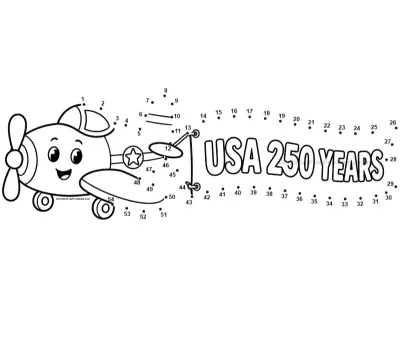
Connect 54 easy dots to reveal a classic biplane trailing a patriotic banner to celebrate America's 250th anniversary! This free printable worksheet helps young children practise number sequencing and pencil control while celebrating 250 years of American history and the pioneering spirit of flight. Perfect for ages 5–7.
Difficulty
Easy
Fun fact: The Wright Brothers made the world's first powered aeroplane flight at Kitty Hawk, North Carolina, on 17 December 1903 — just 127 years after the Declaration of Independence was signed. That first flight lasted only 12 seconds and covered 120 feet, but it changed the world forever.
Downloaded0+timesYou’ve made a great choice!
Downloads now start from the button below. Tap it to get this puzzle's PDF.
Number Version
Connect the numbered dots from 1 to the end to reveal the picture.
Free for home and classroom use.
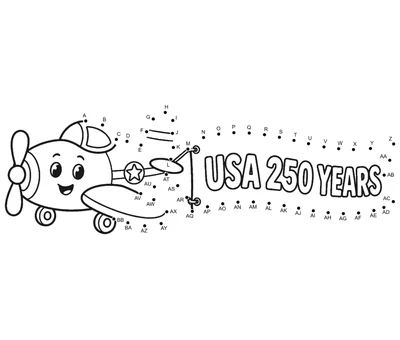
Alphabet Version
Includes alphabet-themed design for easy learning.
No sign-up needed. Opens as a PDF. Print on US Letter (8.5 × 11 inch) or A4 paper. Free for home and classroom use.
America 250 Years
You might also like
Ages 5–7 — Easy
How to Solve the America 250 Anniversary Airplane Banner Dot-to-Dot Puzzle
America is turning 250 years old — and what better way to spread the birthday message than with a patriotic airplane banner streaking across the sky? Since the Wright Brothers' first flight in 1903, Americans have loved pushing the boundaries of aviation. Today, banner-towing planes are a familiar sight at celebrations, beaches, and sporting events from coast to coast. Grab a pencil, find dot 1, and let's get this plane airborne!
1–12 — The Nose and Propeller
Start at dot 1 and connect through to dot 12 to trace the rounded nose of the aeroplane and the spinning propeller out front. These tight curves and angled propeller blades make a lively warm-up that builds precise pencil control right from the start.
Fun fact!
The propeller on a piston-engine aeroplane works just like a rotating wing — each blade is shaped so that spinning it through the air generates forward thrust. Early wooden propellers were hand-carved to exact curves, and skilled craftsmen could shape a propeller that matched a specific engine's power output perfectly.
The propeller on a piston-engine aeroplane works just like a rotating wing — each blade is shaped so that spinning it through the air generates forward thrust. Early wooden propellers were hand-carved to exact curves, and skilled craftsmen could shape a propeller that matched a specific engine's power output perfectly.
13–26 — The Cockpit and Fuselage
Continue from dot 13 to dot 26 to draw the cockpit canopy and the long body of the fuselage. Children practise a mix of curved and straight strokes that capture the sleek, streamlined shape of the aircraft, building confidence and line consistency across a larger section of the page.
Fun fact!
Early aeroplanes had open cockpits with no windscreen — pilots wore leather helmets, goggles, and scarves to protect themselves from the wind and cold at altitude. Enclosed cockpits with glass canopies only became standard on most planes in the 1930s, making flight far more comfortable.
Early aeroplanes had open cockpits with no windscreen — pilots wore leather helmets, goggles, and scarves to protect themselves from the wind and cold at altitude. Enclosed cockpits with glass canopies only became standard on most planes in the 1930s, making flight far more comfortable.
27–38 — The Wings
Trace dots 27 through 38 to draw the aeroplane's outstretched wings. These long, horizontal strokes are a brilliant exercise for smooth, even line control across a wide distance. Encourage children to aim for each dot calmly and let the pencil glide — just like a plane riding a current of smooth air.
Fun fact!
An airplane's wings are shaped and angled to push air downward, and that downward push lifts the entire aircraft up off the ground.
An airplane's wings are shaped and angled to push air downward, and that downward push lifts the entire aircraft up off the ground.
39–47 — The Tail Fin and Rudder
Connect dots 39 through 47 to draw the vertical tail fin and the horizontal stabilisers at the back of the plane. These angled, precise strokes help children practise direction changes and corner points — a great challenge for building careful aim at each numbered dot.
Fun fact!
The tail fin — also called the vertical stabiliser — keeps the aeroplane pointing straight ahead, just like the flights on an arrow. Without it, the nose would swing left and right uncontrollably in the slightest breeze. The smaller horizontal stabilisers above and below it control the up-and-down pitch of the aircraft.
The tail fin — also called the vertical stabiliser — keeps the aeroplane pointing straight ahead, just like the flights on an arrow. Without it, the nose would swing left and right uncontrollably in the slightest breeze. The smaller horizontal stabilisers above and below it control the up-and-down pitch of the aircraft.
48–54 — The Banner and Finishing Touches
Finish the puzzle by connecting dots 48 through 54 to add the flowing patriotic banner being towed behind the plane. Just seven dots to complete the picture — encourage children to draw the ribbon-like banner with a gentle, flowing wrist movement that makes it look as if it's fluttering in the breeze.
Fun fact!
Aerial banner towing began in the United States in the 1920s, when clever pilots realised they could earn extra money by flying advertising messages over crowded beaches and sporting events. Today, banner planes often tow messages hundreds of feet long and can be seen for miles on a clear day.
Aerial banner towing began in the United States in the 1920s, when clever pilots realised they could earn extra money by flying advertising messages over crowded beaches and sporting events. Today, banner planes often tow messages hundreds of feet long and can be seen for miles on a clear day.
Fantastic work — your America 250 anniversary airplane is soaring! That's 54 dots and one sky-high birthday message for America. Colour the plane in red and white with blue star details, and fill the banner with patriotic colours to celebrate 250 incredible years of American history. Happy 250th birthday, USA! Explore more America 250 dot to dot printables to keep the fun going.
Coloring Guide
America 250 Anniversary Airplane Banner: Classic Real-Life Colors
Banner planes are painted in every bright scheme; this red, white and blue set fits one towing an anniversary message.
| Dot Range | Part | Color | Why this color | |
|---|---|---|---|---|
| Numeric | Alphabet | |||
| 1–12 | A–L | The Nose and Propeller | Crayola Scarlet | The spinning propeller is really a rotating wing that pulls the plane forward; red marks the whirling blades. |
| 13–26 | M–Z | The Cockpit and Fuselage | Crayola Sky Blue | Early cockpits were open to the wind; blue suits the long streamlined body behind the seat. |
| 27–38 | AA–AL | The Wings | Crayola Goldenrod | Wings are shaped to push air down and lift the plane; gold catches them in full sun. |
| 39–47 | AM–AU | The Tail Fin and Rudder | Crayola Scarlet | The fin works like the flights on an arrow, keeping the nose straight; red picks it out at the back. |
| 48–54 | AV–BB | The Banner and Finishing Touches | Crayola Sky Blue | Beach banner-towing began in the 1920s United States; blue is a natural banner colour. |
America 250 Anniversary Airplane Banner: Soft Natural Colors
A small plane high in bright sky washes out to pale silver and tan, its markings hard to pick out.
| Dot Range | Part | Color | Why this color | |
|---|---|---|---|---|
| Numeric | Alphabet | |||
| 1–12 | A–L | The Nose and Propeller | Crayola Silver | Sun on the bare metal nose and spinning prop reads as a bright silver blur. |
| 13–26 | M–Z | The Cockpit and Fuselage | Crayola Tan | Fabric-covered fuselages of early planes were doped a pale cream, close to tan. |
| 27–38 | AA–AL | The Wings | Crayola Sea Green | Soft green suits the shaded underside of the wings away from the sun. |
| 39–47 | AM–AU | The Tail Fin and Rudder | Crayola Silver | The tail fin catches the same silvery sky glare as the rest of the airframe. |
| 48–54 | AV–BB | The Banner and Finishing Touches | Crayola Tan | A long banner streaming in bright sun looks bleached and pale along its length. |
America 250 Anniversary Airplane Banner: Bold Real-Life Colors
Deeper tones bring out the plane as a working machine - engine cowl, doped fabric and a heavy towed banner.
| Dot Range | Part | Color | Why this color | |
|---|---|---|---|---|
| Numeric | Alphabet | |||
| 1–12 | A–L | The Nose and Propeller | Crayola Forest Green | Dark green gives the engine cowling around the propeller a solid, oily weight. |
| 13–26 | M–Z | The Cockpit and Fuselage | Crayola Brown | Brown reads like the varnished wood and leather of an open early cockpit. |
| 27–38 | AA–AL | The Wings | Crayola Orange | Burnt orange picks out the wings, the hardest-working surfaces on the whole aircraft. |
| 39–47 | AM–AU | The Tail Fin and Rudder | Crayola Forest Green | Strong green suits the tail fin that fights every gust to hold the plane straight. |
| 48–54 | AV–BB | The Banner and Finishing Touches | Crayola Brown | Deep brown gives the heavy banner cloth its drag as the plane hauls it along. |
Why Is the America 250 Anniversary Airplane Banner Dot to Dot Printable Rated Easy?
The America 250 Anniversary Airplane Banner is rated easy. Of its 54 dots, 38 run in straight lines, with 4 curved, 6 zigzag and 6 sharp-turn dots. The stretch to slow down for is nose and propeller at dots 8–9. Follow the numbered order even when another dot looks nearer, and check the next number before each curve.
Straight
38 dots · 70%
Easiest — join two dots with one straight pencil stroke.
Curved
4 dots · 7%
8 9
Zigzag
6 dots · 11%
Quick in-and-out changes of direction. Good counting practice.
Sharp turns
6 dots · 11%
The hardest bits — tight corners where the line doubles back.
We traced all 54 dots on this exact worksheet by hand to write this — not a generic guess.
Key Sections to Know
Every notable stretch of the path, dot by dot.
| Dot Range | Pattern | Why It Matters | |
|---|---|---|---|
| Numeric | Alphabet | ||
| 8 9 | H I | Curved | Follow nose and propeller as it curls from dot 8 to dot 9, easing the line rather than snapping it. |
Bottom line: The America 250 Anniversary Airplane Banner dot to dot is easy rated — 78% smooth lines with no tricky spots to watch for.