
UAE
Dallah Coffee Pot Dot to Dot — Free 63-Dot Printable for Ages 5–7
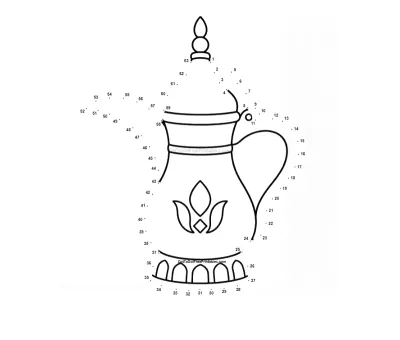
Connect 63 dots to reveal a dallah, the long-spouted coffee pot used across the UAE and the wider Gulf to serve Arabic coffee to guests. This easy puzzle is a nice one for young learners practising number sequencing while getting a small window into a tradition that's still very much alive today.
Difficulty
Easy
Fun fact: The dallah is such a well-known symbol of hospitality that it appears on the UAE's one-dirham coin.
Downloaded0+timesYou’ve made a great choice!
Downloads now start from the button below. Tap it to get this puzzle's PDF.
Number Version
Connect the numbered dots from 1 to the end to reveal the picture.
Free for home and classroom use.
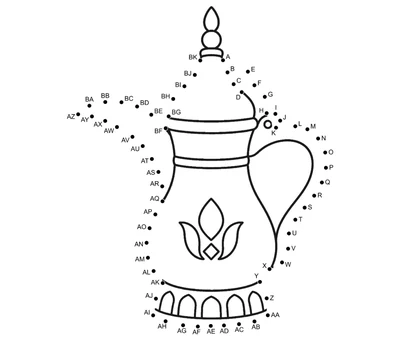
Alphabet Version
Includes alphabet-themed design for easy learning.
No sign-up needed. Opens as a PDF. Print on US Letter (8.5 × 11 inch) or A4 paper. Free for home and classroom use.
UAE
You might also like
Ages 5–7 — Easy
How to Solve the Dallah Coffee Pot Dot-to-Dot Puzzle
Ask almost anyone in the Gulf what a good host offers a guest, and coffee will come up fast. The dallah is the pot that makes it happen — tall, curved, with a long spout built for a slow, careful pour. It shows up at weddings, in majlis sitting rooms, and outside tents at festivals, usually next to a stack of small handleless cups and a plate of dates. This 63-dot puzzle traces its unmistakable shape. Find dot 1 and let's pour the coffee!
1–13 — The Curved Handle
Start at dot 1 and connect through to dot 13 to draw the looping handle at the back of the pot. It's a tighter curve than it looks, so go slow here — rushing this part is where the shape usually gets away from beginners.
Fun fact!
Dallahs are traditionally hammered from brass or copper by hand, a craft passed down through families for generations. A well-made one can last decades with regular polishing.
Dallahs are traditionally hammered from brass or copper by hand, a craft passed down through families for generations. A well-made one can last decades with regular polishing.
14–26 — The Domed Lid
Continue from dot 14 to dot 26 to shape the rounded lid on top, often finished with a small pointed knob. This section is mostly gentle curves, so it's a good stretch for kids still building confidence with rounded lines.
Fun fact!
Some dallahs have a decorative crescent or bird-shaped ornament on the lid instead of a plain knob — a small detail that varies a lot from region to region and maker to maker.
Some dallahs have a decorative crescent or bird-shaped ornament on the lid instead of a plain knob — a small detail that varies a lot from region to region and maker to maker.
27–39 — The Long Pouring Spout
Trace dots 27 through 39 to draw the long, narrow spout that gives the dallah its distinctive silhouette. This is the trickiest part of the drawing — the spout tapers as it extends outward, so encourage kids to draw it in one steady, unhurried stroke rather than several short ones.
Fun fact!
The spout's length isn't just decorative. It lets the host pour coffee from a small height without spilling, which is part of the performance of hospitality — pouring is done in full view of guests, not in another room.
The spout's length isn't just decorative. It lets the host pour coffee from a small height without spilling, which is part of the performance of hospitality — pouring is done in full view of guests, not in another room.
40–52 — The Wide Body
Connect dots 40 to 52 to fill out the rounded main body of the pot, where the coffee itself would be brewing. This is the largest section here, so it's worth pausing halfway through to recount and make sure nothing's been skipped.
Fun fact!
Arabic coffee served from a dallah, known as gahwa, is typically brewed with lightly roasted beans and cardamom rather than the darker roasts common elsewhere — which is why it looks and tastes noticeably different from espresso or filter coffee.
Arabic coffee served from a dallah, known as gahwa, is typically brewed with lightly roasted beans and cardamom rather than the darker roasts common elsewhere — which is why it looks and tastes noticeably different from espresso or filter coffee.
53–63 — The Base and Stand
Finish by connecting dots 53 through 63 to draw the sturdy base the pot rests on. Eleven dots to go — a good, solid finish here anchors the whole drawing.
Fun fact!
In 2015, UNESCO added Arabic coffee to its list of Intangible Cultural Heritage, recognising it as a symbol of generosity shared across the UAE, Saudi Arabia, Oman, and Qatar. See UNESCO's listing for Arabic coffee for more.
In 2015, UNESCO added Arabic coffee to its list of Intangible Cultural Heritage, recognising it as a symbol of generosity shared across the UAE, Saudi Arabia, Oman, and Qatar. See UNESCO's listing for Arabic coffee for more.
Great work — your dallah is ready to serve! Colour it in warm copper or brass tones for a traditional look, or go bold with gold and deep green. Explore more UAE dot to dot printables to keep the fun going.
Coloring Guide
Dallah Coffee Pot: Classic Real-Life Colors
A real dallah is hand-hammered from brass or copper, with darker shadows sitting in the dents. This set uses a bright palette to tell each part apart, so swap in warm metal tones if you want a realistic look.
| Dot Range | Part | Color | Why this color | |
|---|---|---|---|---|
| Numeric | Alphabet | |||
| 1–13 | A–M | The Curved Handle | Crayola Scarlet | The looping handle is hammered from the same sheet as the body; its tight curve catches a bright highlight. |
| 14–26 | N–Z | The Domed Lid | Crayola Sky Blue | The rounded lid is often topped with a small crescent or bird ornament above a pointed knob. |
| 27–39 | AA–AM | The Long Pouring Spout | Crayola Goldenrod | The long tapering spout lets the host pour from a height in front of guests, and is the pot's signature line. |
| 40–52 | AN–AZ | The Wide Body | Crayola Scarlet | The round body is where the cardamom coffee brews, the largest curved surface to colour. |
| 53–63 | BA–BK | The Base and Stand | Crayola Sky Blue | The sturdy foot keeps the full pot steady on a serving tray, so anchor it with a firm edge. |
Dallah Coffee Pot: Soft Natural Colors
A well-polished dallah catches the light and can look pale gold, almost white where it shines, which is the bright look this set uses.
| Dot Range | Part | Color | Why this color | |
|---|---|---|---|---|
| Numeric | Alphabet | |||
| 1–13 | A–M | The Curved Handle | Crayola Silver | A polished handle throws a near-white shine along its outer curve. |
| 14–26 | N–Z | The Domed Lid | Crayola Tan | Light pools on the top of the dome, fading the metal there to pale gold. |
| 27–39 | AA–AM | The Long Pouring Spout | Crayola Sea Green | The thin spout catches the most light and looks almost bleached along its length. |
| 40–52 | AN–AZ | The Wide Body | Crayola Silver | A buffed body reflects the room and softens to a light, warm sheen. |
| 53–63 | BA–BK | The Base and Stand | Crayola Tan | The foot stays lighter where it lifts the pot up off the tray into the light. |
Dallah Coffee Pot: Bold Real-Life Colors
Older, well-used pots darken to a deep reddish copper, and some are enamelled in strong colours, the richer finish here.
| Dot Range | Part | Color | Why this color | |
|---|---|---|---|---|
| Numeric | Alphabet | |||
| 1–13 | A–M | The Curved Handle | Crayola Forest Green | Years of handling darken the handle to a deep, worn copper. |
| 14–26 | N–Z | The Domed Lid | Crayola Brown | Heat and smoke from the fire tarnish the lid to a rich brown-bronze. |
| 27–39 | AA–AM | The Long Pouring Spout | Crayola Orange | Poured coffee stains the spout tip the darkest metal on the whole pot. |
| 40–52 | AN–AZ | The Wide Body | Crayola Forest Green | The fire-facing body takes on a deep burnished copper, the boldest area here. |
| 53–63 | BA–BK | The Base and Stand | Crayola Brown | The foot sits closest to the coals and darkens most, so use a strong tone. |
Why Is the Dallah Coffee Pot Dot to Dot Printable Rated Easy?
The Dallah Coffee Pot is rated easy. Of its 63 dots, 39 run in straight lines, with 9 curved, 10 zigzag and 5 sharp-turn dots. The stretches to slow down for are curved handle at dots 4–5 and domed lid at dots 14–15. Follow the numbered order even when another dot looks nearer, and check the next number before each turn.
Straight
39 dots · 62%
Easiest — join two dots with one straight pencil stroke.
Curved
9 dots · 14%
14 15
Zigzag
10 dots · 16%
Quick in-and-out changes of direction. Good counting practice.
Sharp turns
5 dots · 8%
4 5
We traced all 63 dots on this exact worksheet by hand — the sharp turns at dots 4–5 is where it got tricky, and you can check that against your own printout.
Key Sections to Know
Every notable stretch of the path, dot by dot.
| Dot Range | Pattern | Why It Matters | |
|---|---|---|---|
| Numeric | Alphabet | ||
| 4 5 | D E | Sharp turns | There is a tight angle at curved handle here; treat dots 4 and 5 as two separate short lines. |
| 14 15 | N O | Curved | Follow domed lid as it curls from dot 14 to dot 15, easing the line rather than snapping it. |
Bottom line: The Dallah Coffee Pot dot to dot is easy rated — 76% smooth lines with just 1 short section to watch for.