Dinosaurs
Stegosaurus Dot to Dot — Free 52-Dot Printable for Ages 6–9
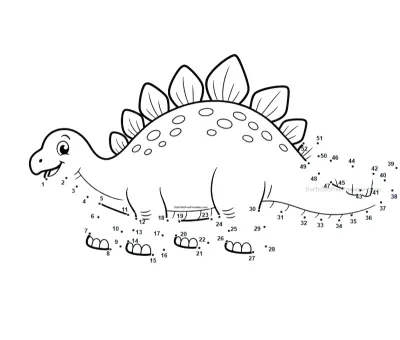
Connect 52 dots to draw the amazing Stegosaurus with its double row of diamond-shaped plates along its back. This detailed connect the dots worksheet for kids builds number sequencing, pencil control, and concentration.
Difficulty
Hard
Fun fact: Stegosaurus had a brain the size of a walnut — but its spiked tail was its superpower!
Downloaded14+timesYou’ve made a great choice!
Downloads now start from the button below. Tap it to get this puzzle's PDF.
Number Version
Connect the numbered dots from 1 to the end to reveal the picture.
Free for home and classroom use.
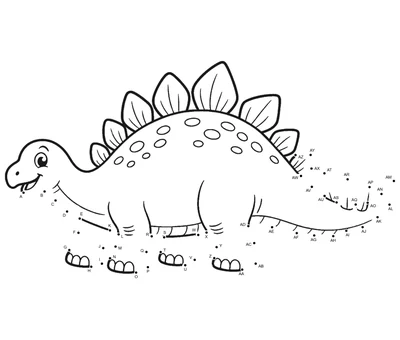
Alphabet Version
Includes alphabet-themed design for easy learning.
No sign-up needed. Opens as a PDF. Print on US Letter (8.5 × 11 inch) or A4 paper. Free for home and classroom use.
Dinosaurs
You might also like
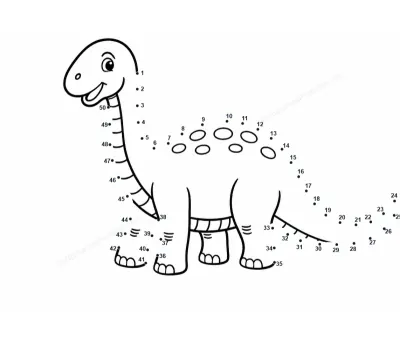
Ages 6–9 — Hard
How to Solve the Stegosaurus Dot-to-Dot Puzzle
With its row of diamond-shaped plates running along its back and four sharp spikes on its tail, the Stegosaurus is one of the most instantly recognisable dinosaurs in the world. This 52-dot puzzle is a tricky one for confident counters aged 6–9 — the shape changes direction often. Find dot 1 and let those magnificent plates take shape!
1–6 — The Neck and Chest
Begin at dot 1, just under the Stegosaurus's chin, and connect down to dot 6 to trace the neck and chest. The head itself is already drawn and waiting — your line simply joins it to the rest of the body. Six dots is a manageable start for little hands building confidence.
Fun fact!
The Stegosaurus had one of the smallest brains relative to body size of any dinosaur — roughly the size of a walnut sitting inside a body about as long as a small bus. Despite this, it survived for millions of years, which is a good reminder that brains are not everything!
The Stegosaurus had one of the smallest brains relative to body size of any dinosaur — roughly the size of a walnut sitting inside a body about as long as a small bus. Despite this, it survived for millions of years, which is a good reminder that brains are not everything!
7–15 — The Front Legs
Connect dots 7 through 15 to draw the two sturdy front legs and their broad, rounded feet. There are a few short direction changes here as the line dips down to each foot and back up, so encourage children to check each number before drawing the next stroke.
Fun fact!
The Stegosaurus's front legs were much shorter than its back legs — almost half the length. That mismatch gave the animal its famous arched back and kept its tiny head close to the ground, perfect for munching low-lying plants and ferns.
The Stegosaurus's front legs were much shorter than its back legs — almost half the length. That mismatch gave the animal its famous arched back and kept its tiny head close to the ground, perfect for munching low-lying plants and ferns.
16–27 — The Belly and Back Legs
Trace dots 16 through 27 to draw the long line of the belly and the powerful back legs. This is the widest stretch of the puzzle so far, and a good place to practise keeping a steady rhythm — dot, line, dot, line — all the way to the back feet.
Fun fact!
Stegosaurus lived around 150 million years ago, in the Late Jurassic period. That is so long ago that the Tyrannosaurus rex lived closer in time to us today than it did to the Stegosaurus!
Stegosaurus lived around 150 million years ago, in the Late Jurassic period. That is so long ago that the Tyrannosaurus rex lived closer in time to us today than it did to the Stegosaurus!
28–38 — Along the Tail
Connect dots 28 to 38 to draw the long underside of the tail as it stretches out behind the body. The dots follow one gentle, flowing curve here, so this is a lovely section for practising smooth, continuous pencil strokes without lifting the pencil too often.
Fun fact!
The plates along the Stegosaurus's back were too thin to be armour. Some scientists think they were filled with blood vessels that helped regulate body temperature, and perhaps flushed red or pink when the animal was excited — and they may have attracted mates, like a prehistoric peacock tail.
The plates along the Stegosaurus's back were too thin to be armour. Some scientists think they were filled with blood vessels that helped regulate body temperature, and perhaps flushed red or pink when the animal was excited — and they may have attracted mates, like a prehistoric peacock tail.
39–52 — The Spiked Tail Tip and Back
Finish the puzzle by connecting dots 39 through 52 to draw the tip of the tail with its four sharp spikes, then travel back up along the top of the tail to meet the last of the back plates. This is the trickiest section, with dots close together around the spikes — a careful finish makes the whole drawing snap into place.
Fun fact!
The tail spikes — palaeontologists call them a 'thagomizer' — could be up to about three feet long, roughly the length of a guitar! Fossil evidence shows the Stegosaurus used them to stand its ground confidently. Even the gentlest plant-eater knows how to look after itself!
The tail spikes — palaeontologists call them a 'thagomizer' — could be up to about three feet long, roughly the length of a guitar! Fossil evidence shows the Stegosaurus used them to stand its ground confidently. Even the gentlest plant-eater knows how to look after itself!
You did it — 52 dots and one spectacular Stegosaurus! Now colour those back plates in your favourite shades. Nobody knows exactly what colour Stegosaurus was, which means any colour you choose is just as valid as a scientist's best guess. Just getting started? Explore more dinosaur dot to dot printables to keep the fun going.
Coloring Guide
Stegosaurus: Classic Real-Life Colors
Books usually give the Stegosaurus body a plain grey-green and save the colour for the plates, which really may have blushed red or pink with blood.
| Dot Range | Part | Color | Why this color | |
|---|---|---|---|---|
| Numeric | Alphabet | |||
| 1–6 | A–F | The Neck and Chest | Crayola Olive Green | Olive green on the low neck and chest keeps the small-headed front end plain, matching a body only as brainy as a walnut but built to last. |
| 7–15 | G–O | The Front Legs | Crayola Forest Green | Forest green on the short front legs, barely half the length of the back pair, shows the limbs that tipped the head down toward low ferns. |
| 16–27 | P–AA | The Belly and Back Legs | Crayola Brown | Brown along the belly and the tall back legs gives the underside the shaded tone artists use where the arched back throws a shadow. |
| 28–38 | AB–AL | Along the Tail | Crayola Olive Green | Olive green down the length of the tail keeps it plain green right up to where the spikes begin. |
| 39–52 | AM–AZ | The Spiked Tail Tip and Back | Crayola Forest Green | Forest green over the tail tip and back meets the row of plates, which stayed thin because they were built for blushing with colour, not for armour. |
Stegosaurus: Soft Natural Colors
Out in Late Jurassic sunshine the Stegosaurus's broad flank would look pale and dusty, and the tall plates might glow where light passed through their thin, blood-filled skin.
| Dot Range | Part | Color | Why this color | |
|---|---|---|---|---|
| Numeric | Alphabet | |||
| 1–6 | A–F | The Neck and Chest | Crayola Gray | Pale grey shows the neck and chest bleached in the open, the tiny head lost against the light. |
| 7–15 | G–O | The Front Legs | Crayola Silver | Silver-grey on the stubby front legs catches the sun on skin stretched over short, sturdy bone. |
| 16–27 | P–AA | The Belly and Back Legs | Crayola Tan | Warm tan across the belly and back legs is how dust-coated hide reads under a bright sky. |
| 28–38 | AB–AL | Along the Tail | Crayola Gray | Grey along the tail keeps the long balancing beam in the same faded midday tone. |
| 39–52 | AM–AZ | The Spiked Tail Tip and Back | Crayola Silver | Silver-grey at the spiked tip lets the three-foot thagomizer spikes stand out as paler bone. |
Stegosaurus: Bold Real-Life Colors
Many modern paintings give Stegosaurus bright, blood-flushed plates and a boldly patterned body, treating it almost like a prehistoric peacock.
| Dot Range | Part | Color | Why this color | |
|---|---|---|---|---|
| Numeric | Alphabet | |||
| 1–6 | A–F | The Neck and Chest | Crayola Raw Sienna | Raw sienna warms the neck and chest, a rich base colour for an animal that may have signalled with its skin. |
| 7–15 | G–O | The Front Legs | Crayola Mahogany | Deep mahogany on the short front legs makes the mismatched limbs part of a bold pattern. |
| 16–27 | P–AA | The Belly and Back Legs | Crayola Goldenrod | Goldenrod along the belly and back legs flashes a bright underside beneath the darker back. |
| 28–38 | AB–AL | Along the Tail | Crayola Raw Sienna | Raw sienna down the tail carries warm colour toward the weapon at its tip. |
| 39–52 | AM–AZ | The Spiked Tail Tip and Back | Crayola Mahogany | Mahogany over the spiked tip and back sets off plates that really could have flushed deep red to show off or warn. |
Why Is the Stegosaurus Dot to Dot Printable Rated Hard?
The Stegosaurus is rated hard. Its 52 dots are 14 straight, 17 curved, 6 zigzag and 15 sharp-turn dots. The stretches to slow down for are neck and chest at dots 5–6 and front legs at dots 8–9. Follow the numbered order even when another dot looks nearer, and check the next number before each curve.
Straight
14 dots · 27%
Easiest — join two dots with one straight pencil stroke.
Curved
17 dots · 33%
5 6
Zigzag
6 dots · 12%
Quick in-and-out changes of direction. Good counting practice.
Sharp turns
15 dots · 29%
The hardest bits — tight corners where the line doubles back.
We traced all 52 dots on this exact worksheet by hand to write this — not a generic guess.
Key Sections to Know
Every notable stretch of the path, dot by dot.
| Dot Range | Pattern | Why It Matters | |
|---|---|---|---|
| Numeric | Alphabet | ||
| 5 6 | E F | Curved | The outline swings around neck and chest here; take dots 5 to 6 in short strokes. |
| 8 9 | H I | Curved | A gentle curve shapes front legs across dots 8–9. Spot dot 9 before you commit to the line. |
| 15 16 | O P | Curved | Follow front legs as it curls from dot 15 to dot 16, easing the line rather than snapping it. |
| 21 22 | U V | Curved | Around belly and back legs, the line eases through a smooth bend at dots 21–22; keep the pencil moving slowly. |
| 24 25 | X Y | Curved | Dots 24–25 round off belly and back legs — connect them one at a time so the arc stays even. |
| 27 28 | AA AB | Curved | The outline swings around belly and back legs here; take dots 27 to 28 in short strokes. |
Bottom line: The Stegosaurus dot to dot is hard rated — 60% smooth lines with no tricky spots to watch for.