Learning
Why Dot to Dot Puzzles Are Good Practice for Young Children
How connect-the-dots builds pencil control, number sense, and quiet confidence — one line at a time.
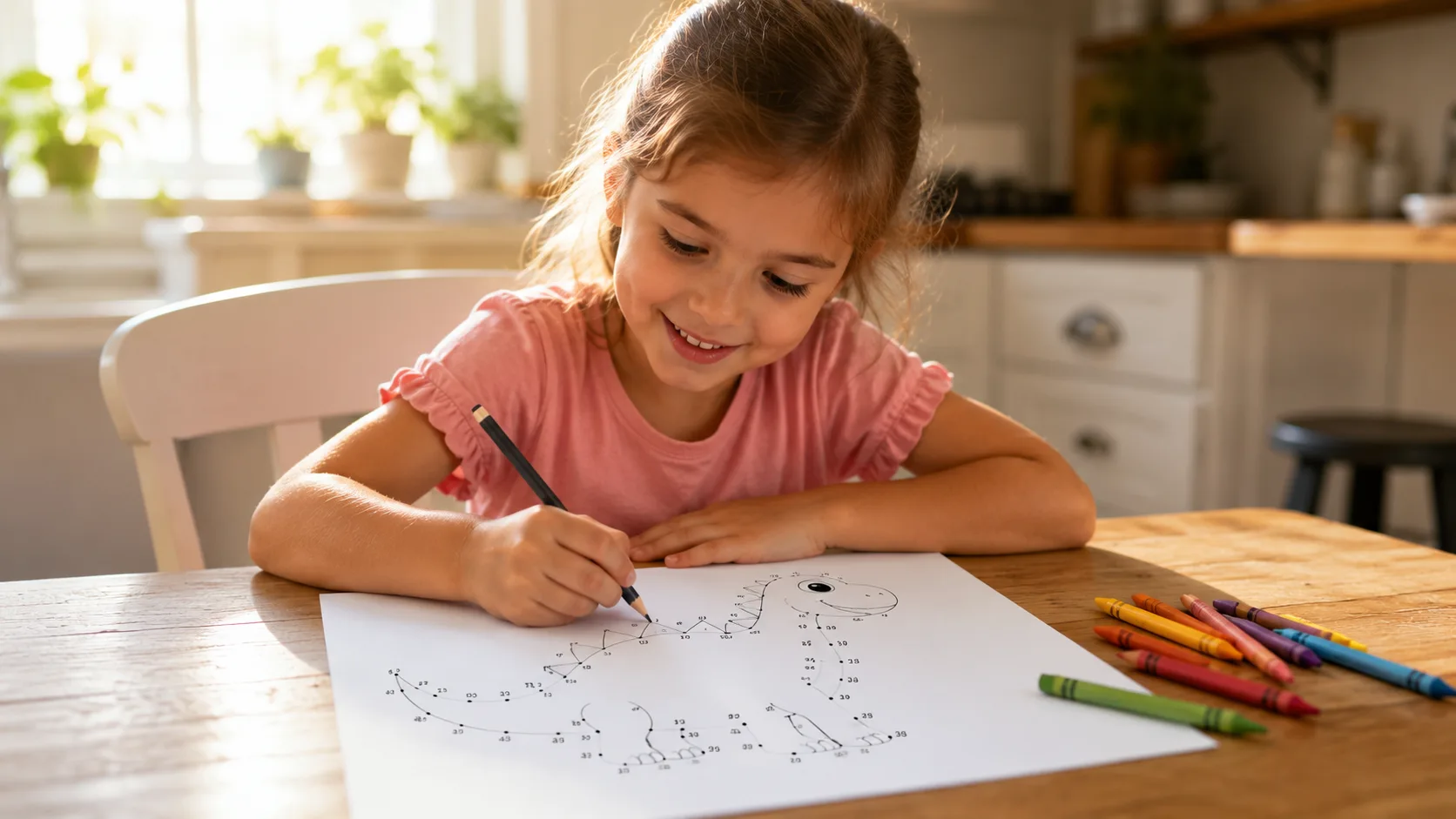
The activities that look simplest are often doing the most work, and connect-the-dots is a good example. To a passing adult, a child connecting numbered dots looks like idle amusement. What is actually happening is more interesting.
A printable dot to dot page gives a child a reason to count in order, slow the hand down and stay with one task until a picture appears. This guide explains why, using published guidance from child-development and education sources.
The hand learns by doing
Fine motor development is one of the things parents hear about most in the early years, and for good reason. The CDC's developmental milestone guidelines include pencil and drawing skills as key markers through age five, and occupational therapists across the country flag pencil control as a foundation for early writing success. Children don't strengthen their pencil grip through lectures about how to hold a pencil. They do it through sustained, purposeful mark-making.
What these activities do is give a child a reason to draw carefully. The dot is small. The line needs to land on it. That combination — intentional movement toward a visible target — is exactly the kind of practice that builds hand-eye coordination and fine motor control in young children.
Counting in sequence is a different skill to counting out loud
Most children can recite numbers from one to twenty without much trouble. But counting in sequence — starting from any given number and following the chain to the next — is a more nuanced skill, and it's one that connect-the-dots activities practice constantly. Under the Common Core counting and cardinality standards used in most US states, kindergarteners are expected to count sequences to 100 and understand number order. Dot to dot worksheets give children a reason to practice exactly that — without it feeling like drill work.
When a child scans the page looking for number fourteen after drawing a line to thirteen, they're not just remembering a list. They're locating a number in space, holding the sequence in mind, and making a decision about where to move next. That's a small but genuine cognitive task, and it happens dozens of times in the span of a single printable connect-the-dots worksheet.
For children who are just learning their teens, or who confuse twenty-three with thirty-two, this kind of repeated, low-pressure practice is invaluable. They're not being tested. They're just looking for the next dot. The learning sneaks in sideways, which is often the best way for it to arrive.
The moment the picture appears
Children are motivated by seeing results. Abstract effort — studying, practising, repeating — is genuinely hard for young children to sustain because the payoff is invisible.
These activities solve this problem beautifully. As the lines accumulate, the image forms. A fin appears. A tail emerges. Suddenly there's a whale where there used to be nothing but numbered dots — something our ocean-themed dot to dot collection captures wonderfully. Children respond to this in the most joyful way — they feel accomplished, surprised, and proud all at once. They want to colour it. They want to do another one.
That feeling of completion matters more than it might seem. It builds the habit of seeing a task through to the end. And for children who often feel uncertain about their abilities, finishing a connect-the-dots activity and seeing something wonderful appear is a small but real piece of evidence that they can do hard things.
Choosing the right printable for your child
Not all connect-the-dots printables for kids are created equal (our playground dot to dot puzzles span a wide range of lengths), and the best one for any given child is the one that sits just at the edge of their current ability. Too easy, and it doesn't hold their attention. Too difficult, and frustration arrives before the picture does.
The easiest puzzles here start at about 35 dots; for a very young child, count along together and let them draw the first stretch. Theme matters too — a harder sheet often feels more manageable when it ends in a T. rex. Our dinosaur dot to dot puzzles are a good place to start.
Printable activity sheets are wonderful for this because you can try a range without any commitment. Print one, sit quietly with the child, watch how they respond, and adjust from there. The right level is the one where they grumble just a little at the hard parts — and then keep going anyway.
The best learning activities are often the ones children don't experience as learning at all. They're just doing something they enjoy.
These printables sit squarely in that category — quiet, portable, screen-free, and quietly doing something important. The American Academy of Pediatrics has long championed hands-on, screen-free play for young children, and these free dot to dot printables fit that guidance. They are a good screen-free thing to put in front of a young child.